
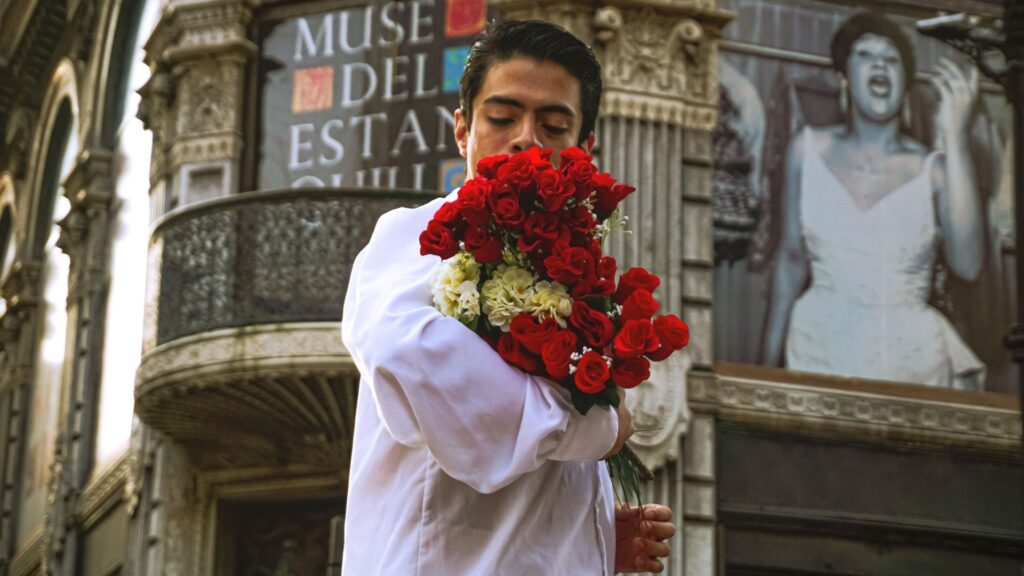
The only time men receive flowers is at their funerals. This unfortunate reality was highlighted in a recent study. Traditionally viewed as a feminine gift, flowers appear to clash with societal notions of masculinity. With Father’s Day approaching, it’s time to swap the conventional toolbox for a beautiful bouquet, fostering a fresh, affectionate practice while bidding farewell to the era of toxic masculinity.
When Flowers Are Only Received at Funerals
While women don’t need a special occasion to find bouquets adorned with sweet messages waiting on their doorstep, men typically receive flowers with “rest in peace” or “tender thoughts” attached. They are no longer around to bask in their beauty and appreciation. The only floral arrangements dedicated to them tend to be chrysanthemums and funeral sprays bearing ribbons marking their journey to the afterlife.
According to a survey conducted by a flower delivery service, 88% of men receive their first bouquet at their funeral. The rest encounter flowers only at retirement parties or during hospital recoveries. Beautiful bouquets are lovingly placed on granite tombstones but seldom grace the kitchen table as fleeting symbols of our love.
Why wait until a man’s death to make a floral declaration? Perhaps it’s because, in the collective imagination, flowers embody fragility, sweetness, and sensitivity—qualities seen as the antithesis of masculinity. Flowers serve as tangible expressions of romance, clenched in the hands of budding gentlemen and discreetly offered as silent ‘I love yous’ to the women in their lives.
Although men often visit florists to treat their partners or mothers, they seldom receive such gifts in return. Instead, they’re typically gifted personalized flasks, artisanal beer kits, or tools for home improvement. These are gifts that align more with societal expectations rather than a colorful array of roses or a whimsical bouquet of wildflowers.
See this post on Instagram
Time to End Outdated Gender Norms
On occasions like Valentine’s Day or other significant dates, men often jostle for position at the florist, and seeing these images tends to warm the heart. Witnessing a man carry a bouquet, eyes obscured by a profusion of leaves, almost feels like a scene from a romantic film. In movies or advertisements, flowers are typically presented by men, suggesting that men can’t be the recipients. Meanwhile, the closest men get to flowers is tending to seedlings in their gardens or nurturing herbs on their windowsills, while bouquets only make it to their hands to end up in someone else’s grasp.
As women propose to their partners and daughters treat fathers to spa days or facials, roles are gradually but surely reversing. Giving flowers to a man instead of a shaving kit or the ever-popular chainsaw isn’t just a floral expression of affection; it’s also about nurturing a more pacifistic and less aggressive masculinity. It’s about delving into emotions historically buried beneath the sentiments of “be strong” and “don’t cry.”
Contrary to claims from obscure forums within the manosphere, flowers are not “just for the weak.” According to a study from Rutgers University, men who receive flowers “exhibit increased sociability and heightened happiness.” Far from being an anesthetic toxin to masculinity, flowers serve as an endless source of joy and well-being, sprouting happiness wherever they go.
A Gift That Takes Root Among Male Celebrities
While women express their desire for blossoms openly and remind others when their vases are empty, men remain somewhat reserved on the topic. Fortunately, public figures are leading by example, arms laden with stems and faces partially hidden behind verdant canopies. Jeremy Allen White, star of the series “The Bear,” has emerged as a pivotal figure in this progressive movement, symbolizing the floral renaissance.
Spotted in March 2024, strutting with a massive bouquet slung over his shoulder and another nestled in a Scottish basket, he spontaneously gained female admiration for showcasing an image far removed from the archetype of the emotionally enigmatic bad boy. This candid shot narrates a new narrative of masculinity—one that is less rigid and more fluid. It’s easy to envision these flowers gracing a vase at home, standing proudly amid carefully prepared meals. For a man to flaunt flowers is to declare, “I reject outdated patriarchal convictions” and “I find pleasure in ways beyond a pint.”
Rock icon Bruce Springsteen famously gifted a bouquet of white roses to Shane MacGowan, the lead singer of the Pogues. Even those in leather jackets and heavy metal attire are breaking tradition, exchanging flowers instead of bottles of spirits.
While offering flowers to men is not yet the norm, those directly involved are taking charge, succumbing to the allure of peonies, sunflowers, and lilies as they browse storefronts. According to a 2021 survey by the Dutch Flower and Plant Foundation, 22% of men would buy flowers for themselves each month.
