
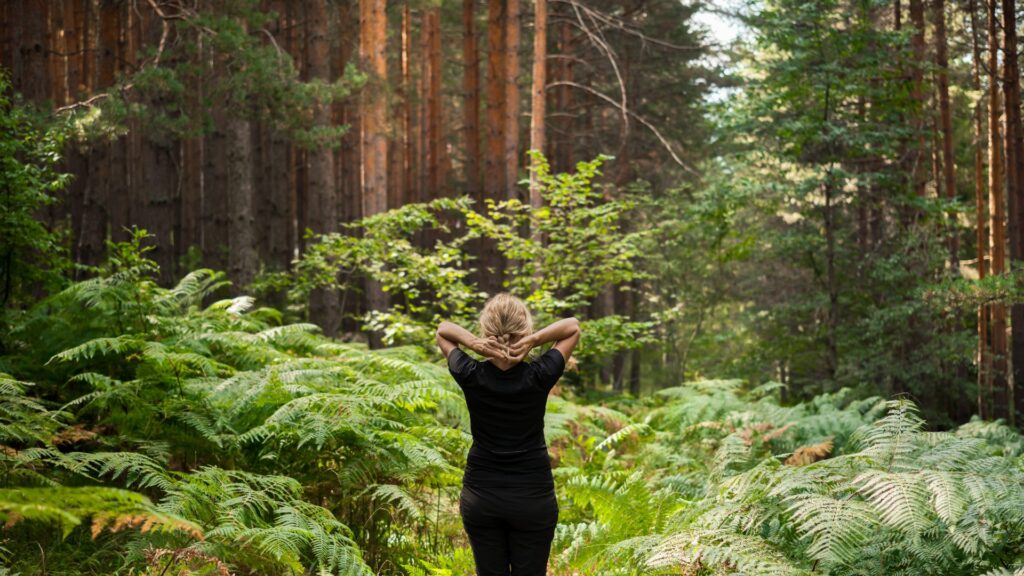
What if slowing down was the most revolutionary thing you could do for your mind and body? Originating from Japan, a gentle and accessible practice invites you to reconnect with nature to ease stress—no pills or performance required. Welcome to the world of shinrin-yoku, or the art of caring for yourself just as you are.
Forest Bathing: An Invitation to Breathe Differently
Shinrin-yoku, which translates to “forest bathing,” is far from a competitive sport or a timed hike. Developed in Japan during the 1980s, it involves leisurely walking through forested areas while fully engaging your senses: listening to the rustle of leaves, inhaling the scent of earth, and observing the light filtering through branches. You’re not trying to reach a destination; you are precisely where you need to be.
This practice emerged in a specific context: a society grappling with extreme work-related stress that, at times, could have fatal consequences. In response to overwhelming burnout, Japanese authorities devised a natural, preventive, and deeply humane solution. Today, shinrin-yoku is officially recognized as a public health resource in Japan.
A Guided Practice… Yet Incredibly Free
Since its institutional launch by the Japanese Ministry of Agriculture in 1982, forest bathing has made its mark in over fifty so-called “therapeutic forests.” These spaces offer guided sessions lasting several hours that focus on slowness, conscious breathing, and a sensory connection with trees. Here, there’s no pressure to push your limits. Your body is respected, listened to, and appreciated. Whether you’re feeling fatigued, are a senior citizen, a busy parent, or simply seeking a moment of gentleness, shinrin-yoku adapts to you, not the other way around.
Scientifically Validated Benefits
What may seem poetic is, in fact, well documented. Scientific studies have compared the effects of a forest walk with an equivalent urban stroll, and the results are compelling: nature triumphs effortlessly.
After a brief forest immersion, the body displays clear signs of relaxation: reduced cortisol levels, lower blood pressure, and improved mood and sleep. Surprisingly, certain immune-related cells show increased activity for several days afterward. Your body, rich and diverse, knows how to regulate itself when given the space to do so.
How to Incorporate Shinrin-yoku Into Your Routine
Good news: no ticket to Tokyo required. A forest, park, or even a garden can become your sanctuary. The key is to slow down intentionally, walk without a specific goal, and allow yourself to feel. Touch the bark, breathe deeply, and leave your phone at the bottom of your bag.
In the greater Paris area, locations like the Bois de Vincennes, the Forest of Fontainebleau, or the Park of Saint-Cloud provide ideal backdrops for this reconnection. And if two hours feels too long, start with less: your body will guide you.
A Gentle, Inclusive, and Pressure-Free Therapy
The secret of shinrin-yoku lies not only in the natural substances emitted by trees but also in the overall experience: you are enveloped, supported, and never judged. No body is “too much” or “not enough” for the forest.
Easy to integrate into urban life, forest bathing can become a weekly ritual, a complement to meditation, or simply a reminder that you have the right to slow down. Free of charge and without side effects, shinrin-yoku presents a modern solution to a world that moves too quickly. Perhaps your next prescription should be a stroll among the trees?
