
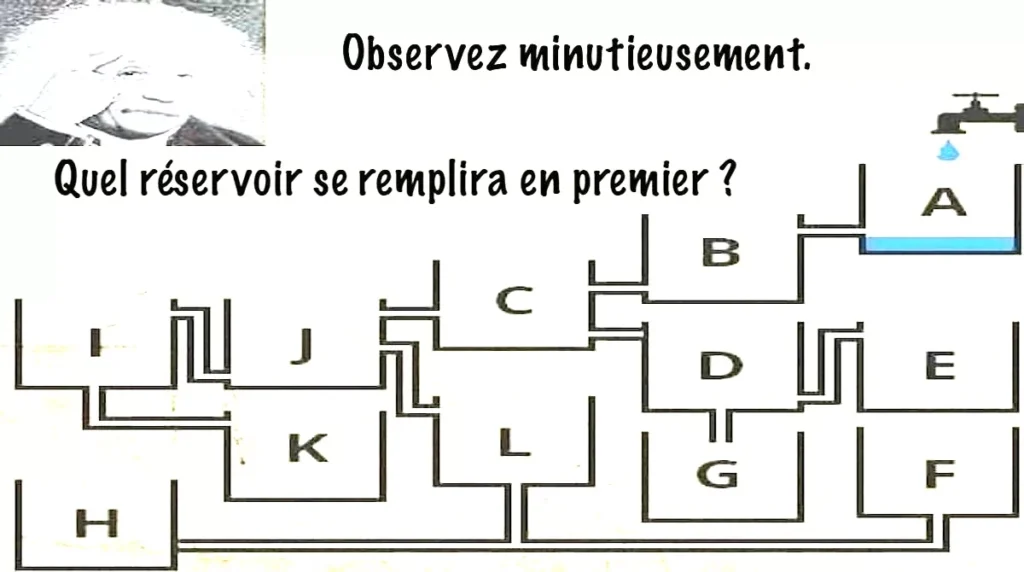
The Puzzling Question: Which Container Will Fill Up First?
A riddle is currently making waves on social media. It features a faucet pouring water into a series of containers labeled A to L. The objective seems simple at first: guess which container will fill up first. However, as is often the case with these visual puzzles, things aren’t as straightforward as they appear…
Many internet users have been scratching their heads, trying to trace the water’s path through the pipes, elbows, and blockages. Some containers are interconnected, while others seem isolated or blocked. At first glance, one might think the closest container to the faucet will obviously fill up first. Yet, it’s rarely that simple!
A Riddle That Made Waves on X (formerly Twitter)
It all started with a simple post from a user:
“Which one?”
Here’s the riddle to solve:
This brief message was accompanied by the famous diagram of pipes. The post quickly went viral, racking up countless views. In the comments, everyone shared their theories, often with confidence and sometimes a touch of humor.
Internet Users Go Wild
Here are some of the most popular reactions from the post:
“K. Look at what’s blocked!” claimed one user.
Another added: “In terms of flow, A would fill up first with enough capacity.”
“F, assuming the faucet only drips,” suggested a third user.
A fourth elaborated: “G. A goes into B, B goes into C, I’ll drill a hole to connect C and D, D flows into G, and G fills up.”
“K if the faucet’s flow is fast, and F if slow. I need to replicate the experiment to be sure!”, commented a fifth.
Finally, one user concluded: “A. Assuming there’s only a single drop, as depicted in the image.”
In other words, everyone has a different theory! And that’s precisely what makes these kinds of riddles so addictive — we can’t help but try to understand, even if it takes us a long time.
The Allure of Viral Puzzles
This puzzle is part of a long line of visual and logical challenges circulating on social media. They are easily shareable, quick to grasp, yet incredibly frustrating when the solution eludes us.
Ultimately, this is what drives their popularity: they pique our curiosity, stimulate our logic, and challenge our ego.
So, which container would you choose?
So, which container do you think will fill up first? Take the time to observe, imagine the water flow, identify the blocked pipes… and take your chance.
Bonus: Another Viral Logic Challenge
In a similar vein, another video has recently gone viral. It features a man asking passersby a math riddle:
“10 / half – 2.”
Some claim the answer is 3, others say 0, while many are still searching…
The correct calculation is actually simple if you follow the order of operations carefully. Can you also solve this little challenge that has become viral?
Here’s the solution we found:
Step-by-step Process and Reasoning
The water starts in A.
The faucet fills A. A will fill up to the level of the first opening that allows the water to flow into the connected containers.
Checking A’s exits:
In the diagram, the opening that connects A to the left (to B/C) is relatively high. When A overflows, the water can flow into the central part of the network. There is no direct and low exit from A that would immediately cause a lower container to fill (thus A does not “empty” instantly into a lower recipient).
Following the path: B, C, D… connections are blocked or high
As we follow the plumbing to the left and downwards, we notice several sections where the openings are higher than the level the water initially stays at in A: these openings act like locks until the upstream reservoirs reach a certain level. Thus, the water will first fill the parts of the network whose entrance is lowest possible after A.
Descending into the lower network — the role of the large lower canal
The diagram then shows a horizontal pipe at the bottom connecting several reservoirs (H, K, L, G, F, …). Several small “vertical bridges” to this canal are blocked or placed higher, except for one: the one feeding K (or allowing water to flow down to it) is the first to become active when the water reaches the right level. In other words, by gradually rising, the water reaches the exit that leads to K before activating the other exits leading to F, G, etc.
K fills up first
Since the connection to K is the first unblocked and accessible by gravity to reach its overflow threshold, K receives water before all the others. The other containers remain blocked by edges or higher openings and are only reached after K has already started to fill.
Why not A, F, G (quick explanations)
- A: even though A is the original container, it is not the one that remains full as a final— it overflows into the network. In some confused versions of the riddle, it’s called “first” when the image shows just a drop; here the statement asks which reservoir in the network will fill first due to the connections—so A isn’t the correct interpretation if we follow the logic of the drawn pipes.
- F: several comments suggest F if the faucet drips. This arises from a reading where one believes a small drop flows directly to F via a low connection. But in this specific drawing, the path to F is blocked longer (or lower) than the path to K.
- G: the same logic—G only receives water after certain other connections have been activated or virtual blockages lifted; its connection is lower/posterior to that of K.
Important Note (visual uncertainties)
This type of riddle heavily depends on the precise levels of edges and openings in the diagram (height of lips, small U’s in the pipes, etc.). I base my conclusion on a careful observation of the provided image: the connection leading to K becomes the first opened by gravity when A overflows.
If the drawing had a slight difference (a hidden line, an invisible lower opening), the outcome could change—this is why on social media some have suggested F, A, or G: many rush too quickly or interpret a few small details differently.
