
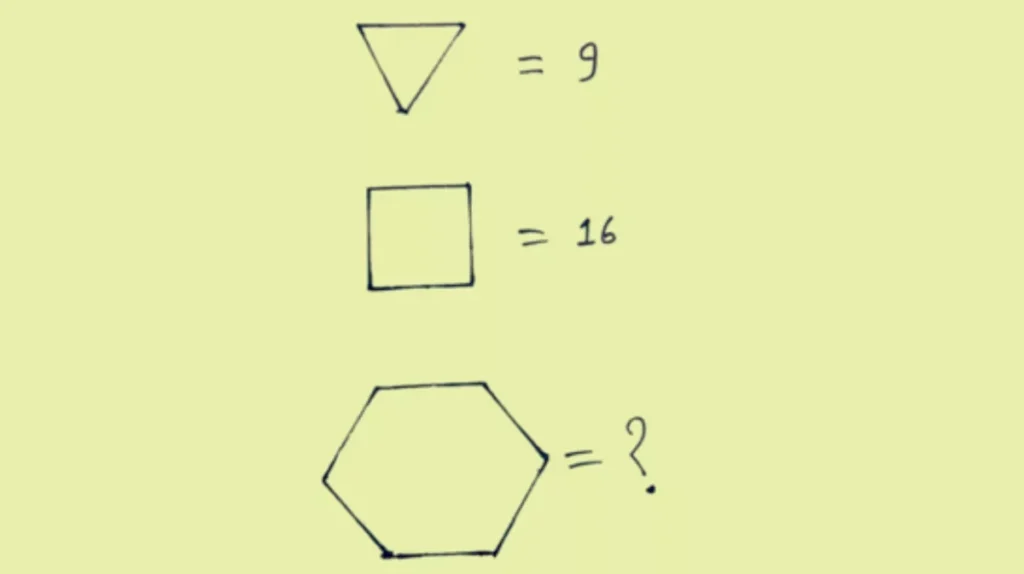
A Visual Puzzle That Challenges the Mind
A test shared on social media challenges users to find a missing number using a shape-based logic. Puzzles have this strange ability to capture our attention, pique our curiosity, and challenge our way of thinking. Whether it’s a complex riddle, a visual illusion, or a logical puzzle, these mental challenges provide an enjoyable and stimulating escape from routine.
They not only test our reasoning and observation skills but also invite us to think outside the box.
In the digital age, these puzzles often go viral. Social media users rush to solve them first, eager to showcase their insight and demonstrate their quick thinking.
The Challenge
The visual challenge presents three familiar geometric shapes arranged in a sequence:
- An inverted triangle marked with the number 9
- A square displaying the number 16
- An hexagon with a question mark (?)
At first glance, it may seem like a simple random arrangement of shapes and numbers.
However, the challenge lies in identifying a logical pattern linking the number of sides of each shape to the number inside.
Breaking Down The Clues
Here are the basic elements to analyze:
- A triangle has 3 sides and its value is 9
- A square has 4 sides and its value is 16
- An hexagon has 6 sides and its value is unknown
This is a classic example of how simple shapes and numbers can be combined to create a real puzzle, provided one applies clever logic.
Why These Puzzles Intrigue The Internet
The Internet’s fascination with puzzles stems from their ability to capture attention in seconds while generating massive engagement.
These challenges foster friendly competition, spark lively discussions in comment threads, and often evoke nostalgia related to riddles and logic exercises from our youth.
In the case of this visual logic puzzle, users compete to share their solutions: some based on rigorous reasoning, others on wild guesses—all in a spirit of fun, mental challenge, and collective endeavor.
And you, have you found the solution?
Here Is The Solution We Found:
Step 1: Observing The Shapes And Numbers
Inverted Triangle
Number of sides: 3
Result: 9
Square
Number of sides: 4
Result: 16
Hexagon
Number of sides: 6
Result: ?
Step 2: Looking For A Mathematical Relationship
Hypothesis 1: Multiplying The Number Of Sides By Itself
Triangle: 3 × 3 = 9
Square: 4 × 4 = 16
So for the hexagon: 6 × 6 = 36
This makes sense. We are applying a relation of “the square of the number of sides”.
Step 3: Verifying The Logic
Assumed formula:
Value = (Number of sides)²
Triangle: 3² = 9 ✔️
Square: 4² = 16 ✔️
Hexagon: 6² = 36 ✔️
Conclusion
The missing number inside the hexagon is:
36
And remember, if you don’t want to keep having fun with tests and challenges, definitely don’t click here.
