
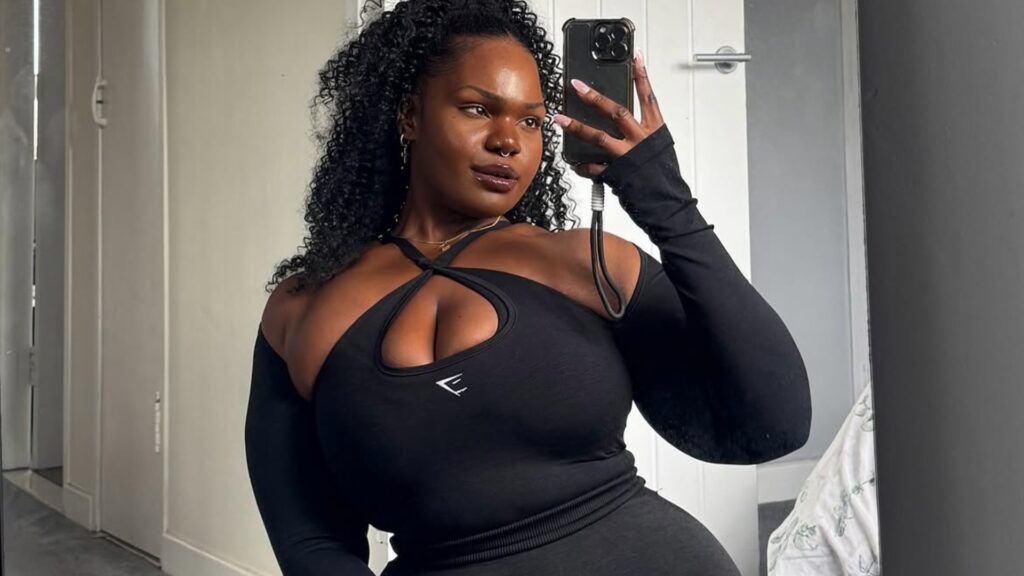
Some men believe that women should stick to a few core exercises on a foam mat, engage in moderate fitness activities, and meticulously avoid the free weights section, which they assume is exclusively meant for men. In response to those who grimace at the sight of women lifting dumbbells and pursuing Herculean routines, this bodybuilder confidently showcases her powerful shoulders and bulging arms.
A Display of Strength That Shatters the Weak Woman Myth
On social media, whenever women proudly display their well-defined physiques enhanced by weight training and share their intimidating heavy-lifting sessions, men often react with alarm. They worry about their femininity and argue that such strength diminishes their attractiveness, diminishing their chances of winning hearts. They call for modesty in muscularity, suggesting that women remain athletic without overshadowing them with their impressive builds. After all, it wouldn’t do for men to feel inferior; they must maintain some semblance of credibility in the face of danger.
In societal ideals, women are expected to avoid excessive muscle mass, focusing instead on toning, slimming, and sculpting through leg swings, bodyweight lunges, and light arm movements with dumbbells that weigh less than the brain of a hater—barely a few grams. However, @kechynara refuses to allow narrow definitions of femininity to dictate her workouts.
This content creator shatters the stereotype of the fragile, defenseless woman with every firm movement she makes. She trains not to lose weight but to lift it, continuously testing her physical limits. Observers can catch her effortlessly yanking an entire stack of weights in a vertical row, visibly struggling during an intense leg day, and extending her arms like an eagle spreading its wings.
View this post on Instagram
Lifting Dumbbells While Encouraging Haters to Weigh Their Words
This remarkable woman, reminiscent of Lara Croft, Wonder Woman, and She Hulk, chronicles her fitness journey online in a manner akin to a personal odyssey. Beyond being an inspiring example of female strength, she conveys messages that resonate deeply: “I celebrate myself because many versions of me have fought for this peace and confidence,” she proclaims in a heartwarming post.
For her, workouts symbolize more than mere exercise; they represent reconnections with herself, acts of self-love rather than just leisurely pursuits. “The gym is my therapy,” she asserts in another post. Even when she appears to struggle on camera, she emerges with a lighter heart and solid self-esteem.
Rejecting the image often portrayed in mainstream fitness marketing, she is not attempting to mimic the women on promotional posters. Having reached the peak of her confidence, she not only uplifts herself but also challenges her critics by flexing her muscles and striking poses reminiscent of ancient gods. The dumbbells she lifts, accompanied by a defiant gaze, serve as formidable tools against her detractors.
The Fear of Muscular Women Underlying the Taboo
The visceral reactions to muscular women extend beyond matters of personal taste or aesthetics. For centuries, physical strength has been largely perceived as a masculine trait. Witnessing a woman lift heavier weights than some men disrupts a long-standing hierarchy that was once regarded as natural.
Recurring themes emerge in the comments on these videos, where critics often claim that these athletes “look like men,” that they’re “losing their femininity,” or that they will struggle to find partners, as if physical activity must always align with a masculine gaze. Rooted in these sentiments is the common notion that a woman may be athletic—so long as she never surpasses the strength of those watching her.
Through her videos, @kechynara ultimately asserts a simple truth: dumbbells possess no gender. A loaded barbell demands neither an ID nor specific chromosomes to be lifted. It rewards only effort, consistency, and discipline. The more women claim this space, the more they erode the belief that their bodies ought to be delicate, light, or fragile in order to be accepted.
In essence, the real weight that this athlete lifts may not be indicated by the numbers on the weight plates. Instead, it embodies decades of stereotypes that have linked strength with men and fragility with women. With each repetition, she demonstrates that a woman need not appear weak to be feminine, nor must she apologize for her strength to embrace her true self.
