
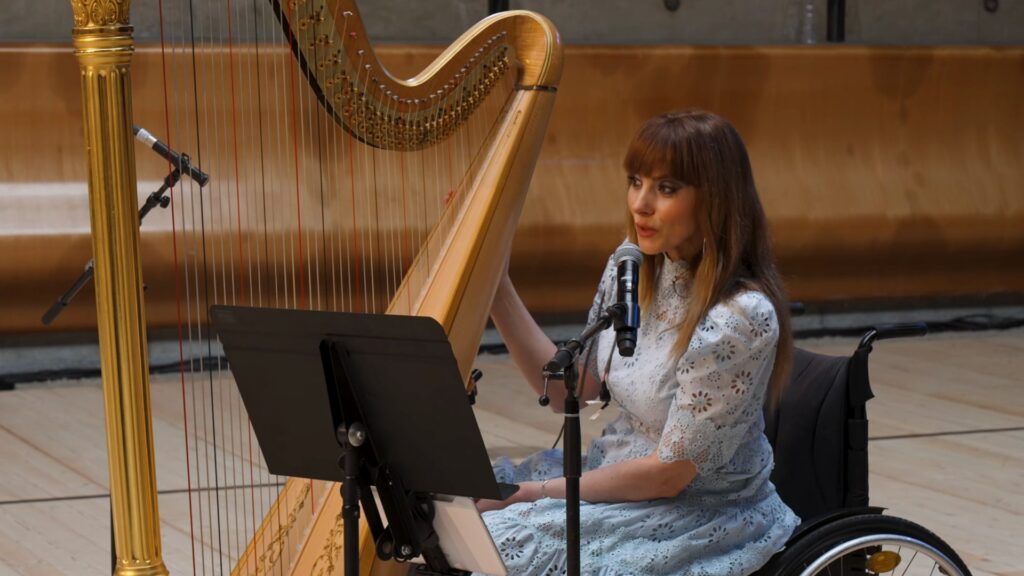
Renowned French harpist Anja Linder sets the tone for diversity on opera stages, resonating with the melody of resilience every time she steps into the spotlight. This virtuoso closed the 2024 Paralympic Games with her beloved instrument—imposing in size, yet gentle in sound. Although she lost the use of her legs in an accident during a live performance, she continues to showcase her talent, embodying the adage that music soothes the soul.
An Accident That Could Have Altered Her Career
Anja Linder had a bright future ahead. Born to a pianist mother and a visual artist father, she was fortunate to grow up in a home where creativity thrived. She inherited that artistic spirit and developed a passion for a rather uncommon instrument for a child: the harp.
At just nine years old, she began to play this ethereal instrument, and the magic came almost effortlessly. Anja possesses an innate talent for this discipline, demanding dexterity and coordination. Once she strikes the first note, she seems to ascend to the heavens, leaving her audience in a state of weightlessness. The harp, often seen as a symbol of paradise, transcends mere extracurricular interest for her; it becomes an extension of her body, her reason for being, and her daily inspiration.
She naturally pursued her studies at the Conservatoire de Strasbourg, aiming to turn her passion into a full-time career. Crowned with first prizes in harp and chamber music, she stood out among her peers as one of the brightest talents of her cohort. However, her rapid rise to success was brought to an abrupt halt by a tragic accident on July 6, 2001. While attending an outdoor concert at the Parc de Pourtalès, she found herself in the wrong place at the wrong time, trapped beneath a uprooted tree during a fierce storm. The aftermath was devastating: 13 lives lost and 97 injured. At just 26 years old, Anja was forced to grieve the loss of her legs—critical for operating the harp’s seven pedals.
View this post on Instagram
An Opportunity to Reinvent Her Art
This irreversible accident seemed to signal the end of both her career and her most profound passion. Without the use of her legs, continuing her path as a concert artist with a traditional instrument appeared nearly impossible, verging on an unattainable dream. Those around her urged her to consider stepping away and even suggested a career change. However, Anja chose to disregard this refrain, opting instead to adapt her beloved instrument—one she considers to be an integral part of her identity.
Determined to reconnect with the sensation of the strings beneath her fingers, she collaborated with two engineers to redesign her harp, which she lovingly named Anjamatic, a tribute to her personal journey.
She then had to learn to master this custom instrument and rethink her entire approach to playing. Thanks to this innovative adaptation, showcasing her tenacity and artistic spirit, Anja has emerged as a beacon of possibility—a bearer of dreams. The accident could have distanced her from her craft, but in reality, it strengthened her ambitions.
Music as a Form of Therapy
In 2024, she reached new heights by participating in the closing ceremony of the Paris 2024 Paralympic Games, solidifying her position among the elite tier of classical music. The following year, she was also honored by the Ministry of Culture, receiving the title of Officer of the Order of Arts and Letters.
Rather than lamenting her disability, Anja celebrates it exuberantly, effectively silencing stereotypes that often accompany it. While her mobility may be limited, her imagination knows no bounds.
