
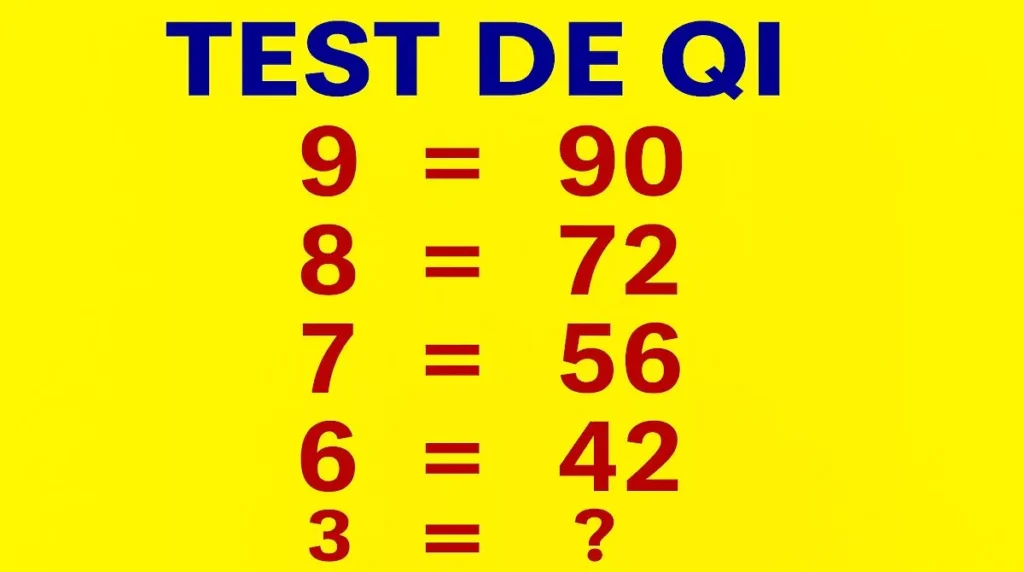
A Math Puzzle That’s Heating Up Social Media
A tricky math puzzle recently shared on social media has left many users puzzled due to its subtle patterns and unexpected logic. These riddles have become a staple of online entertainment, combining reflection, fun, and a hint of intellectual competition.
Math puzzles, in particular, attract an audience passionate about number sequences, pattern recognition, and cognitive challenges.
Whether during casual scrolling on social media or in more in-depth discussions on specialized forums, these challenges provide a stimulating and rewarding mental break.
From students to seasoned professionals, many see these puzzles as a playful way to test their logic or to take on a challenge for enjoyment.
The Latest Challenge That’s Captivating Internet Users
A new math puzzle has recently emerged.
Here’s the shared message:
IQ TEST
9 = 90, 8 = 72, 7 = 56, 6 = 42, 3 = ?
At first glance, this might seem like a simple series of equations, but a closer look reveals a hidden pattern that requires logical analysis.
Hundreds of users have tried to crack this mystery, sparking a wave of debates and hypotheses in the comments.
Another Intriguing Puzzle
This is not the only math challenge to have captured attention. Another riddle shared on social media has also caused confusion among users:
While these equations seem to defy traditional arithmetic rules, they suggest a more complex underlying logic.
These puzzles often play with squares, cross multiplications, or other inventive logical systems, encouraging participants to think differently.
Why Are These Challenges So Fascinating?
Solving a riddle that appears impossible is a universally gratifying experience. These brain teasers captivate by striking the perfect balance between complexity and satisfaction. They are quick to share, addictive, and designed to stimulate curiosity.
In a world where attention spans are fleeting, puzzles manage to hold interest and spark genuine conversations. Their compact yet profound format makes them ideal content for social media platforms.
Here’s The Solution We Found:
Step 1: Observe The Given Pairs
Let’s start by analyzing the proposed equalities:
9 = 90
8 = 72
7 = 56
6 = 42
We need to identify the hidden model or rule that connects the left-side numbers to the right-side results.
Step 2: Examine Simple Products
Let’s test a direct multiplication:
9 × 10 = 90
8 × 9 = 72
7 × 8 = 56
6 × 7 = 42
We can see a clear pattern:
Each number is multiplied by the number just below it.
- n × (n – 1)
Step 3: Apply The Rule To 3
Following this logic:
- 3 × (3 – 1) = 3 × 2 = 6
Final Answer:
3 = 6
And remember, if you don’t want to keep having fun with tests and challenges, don’t click here!
