
Mathematics In A New Light
Math is often seen as complex, even intimidating. Yet, behind the numbers and equations lie fascinating puzzles that invite us to think differently. When presented as challenges, they transform into a true intellectual playground, awakening both logic and creativity.
Today, an increasing number of enthusiasts share these brain teasers online, bringing together a curious community eager to stretch their minds and tackle ever more stimulating challenges.
A Riddle That Has People Talking
Recently, a simple fraction made waves across social media. At first glance, it seems easy, but it has left many internet users puzzled. While some solved it in seconds, others became tangled in the reasoning, reigniting the age-old debate between intuition and mathematical rigor.
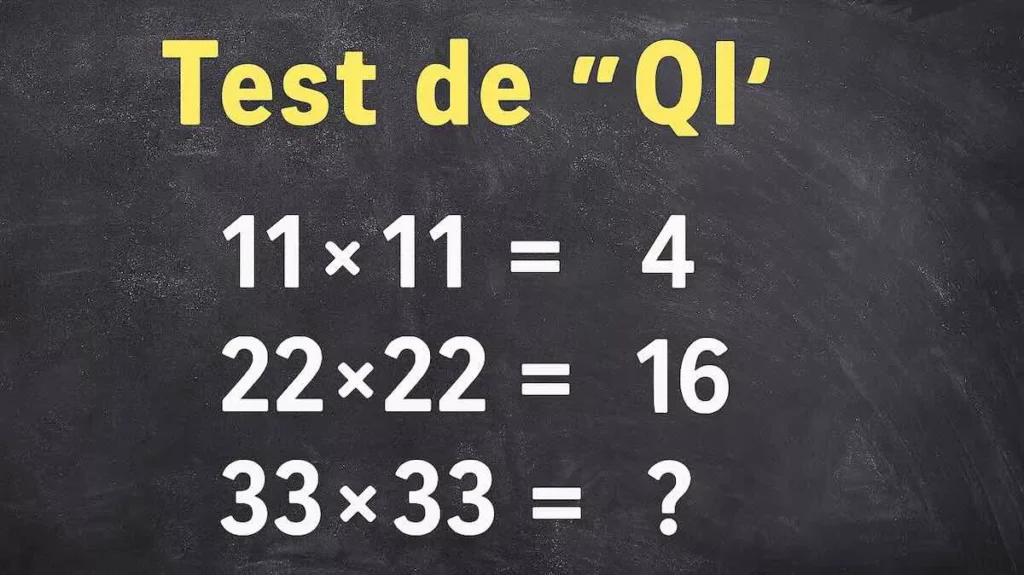
The challenge is presented as follows:
At first glance, this seems obvious, but as often happens with such riddles, there is a subtle trick. To solve it correctly, careful consideration of the order of operations is required.
So, are you able to find the correct answer without making a mistake?
A Personal Memory: Discovering Math in Middle School
I remember one afternoon in sixth grade during a math lesson. We were tasked with solving a series of small logical problems. One of them seemed far too simple, almost suspicious. I quickly wrote down an answer, confident in my reasoning… but it was wrong.
Our teacher then took the time to show us that sometimes, what appears obvious at first glance can be misleading. He taught us to step back, analyze each piece of data calmly before rushing in.
That day, I understood that math is not just about fast calculations—it’s primarily about reflection, method, and attention to detail.
Why Do We Love Math Puzzles?
Math riddles are captivating because they challenge our brains, pushing us to think differently and stimulating our critical thinking.
They are an excellent way to test our abilities while having fun.
Online, they become a space for exchange and sharing where everyone can propose their methods and discuss different ways to solve a problem. The satisfaction of finding the correct answer encourages many to return again and again.
Your Turn to Play!
So, are you ready to take on this math challenge?
The challenge is set, the riddle is here, ready to be solved. Take your time, lay out the operations on paper, think about the rules of calculation, and try to find the correct answer.
And remember, feel free to share your solution with your friends or online to see who can find the answer in the blink of an eye!
Here Is The Solution We Found:
How to proceed?
The Riddle
It presents seemingly false equations:
- 11 × 11 = 4
- 22 × 22 = 16
- 33 × 33 = ?
At first glance, this makes no sense at all because:
- 11 × 11 = 121
- 22 × 22 = 484
- 33 × 33 = 1089
Yet, we are given:
- 11 × 11 → 4
- 22 × 22 → 16
So… what is really going on? Clearly, there is a hidden reasoning, often based on a play of numbers or another type of logic.
The Key Observation
Let’s take the actual results of the operations and look at the digits that compose them:
- 11 × 11 = 121 → 1, 2, 1
→ Count the number of odd digits: 1 and 1 → 2 odd digits
→ Count the number of even digits: 2 → 1 even digit
→ Total of odd × even digits = 2 × 1 = 2
But we are given 4, not 2.
So that isn’t the correct logic. Let’s try another approach:
New Hypothesis: Number of Segments in the Digits
A viral method is to count the segments (or strokes) used to write the digits on a digital screen (like on a calculator).
Here are the segments used for each digit:
- 0 → 6 segments
- 1 → 2 segments
- 2 → 5 segments
- 3 → 5 segments
- 4 → 4 segments
- 5 → 5 segments
- 6 → 6 segments
- 7 → 3 segments
- 8 → 7 segments
- 9 → 6 segments
Now, let’s look at the results:
1. 11 × 11 = 121
121 = digits 1, 2, 1
→ Segments: 2 + 5 + 2 = 9
But the result given is 4, so that doesn’t fit either.
2. 22 × 22 = 484
484 = digits 4, 8, 4
→ Segments: 4 + 7 + 4 = 15
But displayed result = 16, that’s not it either.
New Hypothesis: Extracting Digits and Transforming Them
What if we tried taking the unit digit of each number?
11 × 11 → 1 × 1 = 1, and 1 + 1 = 2 → 2² = 4
22 × 22 → 2 × 2 = 4, and 2 + 2 = 4 → 4² = 16
33 × 33 → 3 × 3 = 9, and 3 + 3 = 6 → 6² = 36
Answer: 36
Conclusion
The logic seems to be:
Take the unit digit of each number, add them together, and then raise that sum to the square.
Example:
33 × 33
→ units = 3 and 3
→ 3 + 3 = 6
→ 6² = 36
Final Answer: 36
If you enjoyed this puzzle, don’t forget to tackle more challenges from our recommended reading section by clicking here.
