
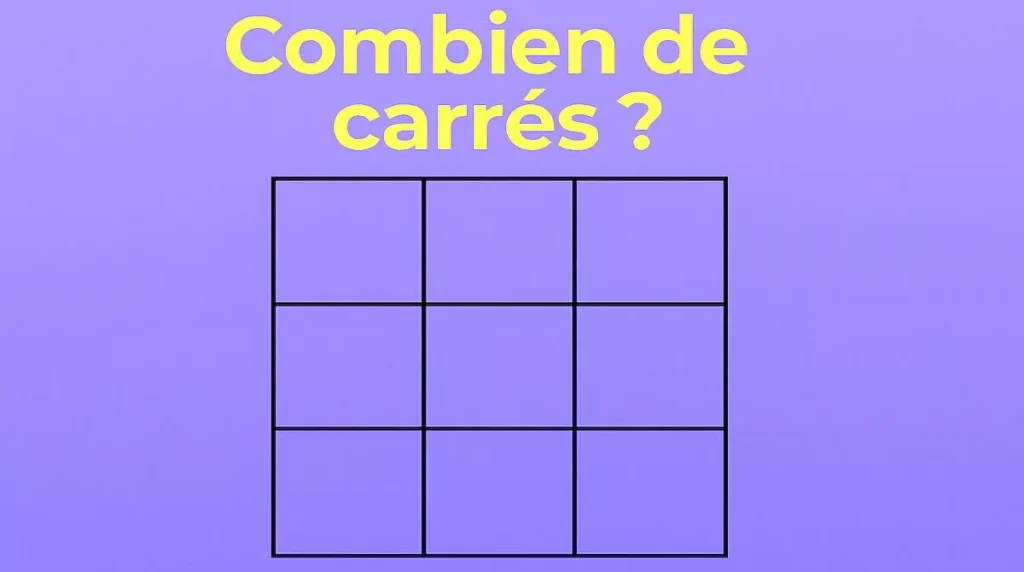
At first glance, this grid of squares seems straightforward. A game of lines, surfaces, and a simple question: “How many squares do you see?” One might think the answer lies in a mechanical counting, a neatly arranged addition. However, this apparent simplicity is deceptive; it conceals a subtle trap, an intricacy invisible at first sight.
The Squares That Slip Away
You start counting. The small squares, easy to spot, add up quickly. Then come the larger squares, formed by the combination of several smaller ones. You hesitate, go back, and recount. Does this one really count?
Have I forgotten something?
The squares play hide and seek with our minds, and each line becomes a blurred boundary between what is obvious and what remains to be discovered.
The Anecdote of Einstein and the Patience of the Mind
It is said that Albert Einstein, when he taught his first classes in Zurich, sometimes presented his students with seemingly childish problems: counting lines, assembling shapes, drawing simple geometric figures.
The students laughed, thinking such exercises were beneath their level. But Einstein insisted: “True genius does not reside in apparent complexity, but in the ability to see the extraordinary in the mundane.”
These visual puzzles, he said, are like mirrors: they not only reveal the answer but also uncover our way of thinking. Those who stop too quickly at the obvious remain prisoners of their first impressions. Those who explore, who doubt, and who observe with patience eventually see what others have missed.
The True Challenge
The real interest of this puzzle is not just to arrive at an exact number. It is to test attention, patience, and learn to look differently. Each square is a silent clue, each line a path to logic.
So, will you be able to unravel the mystery of this grid?
Will you manage to count not only what is apparent but also what hides in the corners and invisible combinations?
The correct number of squares is right there in front of you. But first, you must learn to see.
Here Is The Solution We Found:
1. Observe The Base Grid
The image shows a large grid composed of 9 small squares arranged in 3 rows and 3 columns. At first glance, one might think there are only these 9 squares, but the puzzle is more nuanced.
2. Count The Individual Squares
- 9 squares of size 1×1: These are the smallest squares that fill the base grid.
3. Look For Larger Squares
The trick lies in the fact that larger squares can be formed by combining the smaller squares. Here’s how to identify them:
4 squares of size 2×2:
Top left
Top right
Bottom left
Bottom right
1 square of size 3×3:
The large square that encompasses the entire grid.
4. Add All The Squares
To get the total, simply sum up all the identified squares:
- 9 squares (1×1) + 4 squares (2×2) + 1 square (3×3) = 14 squares.
The possible solution is 14 squares.
5. Conclusion
By observing carefully and counting methodically, we discover that the grid contains a total of 14 squares.
If you enjoyed this test, don’t forget to check out more tests or challenges in our recommended reading section by clicking here.
