
Strengthening your glutes without leaving the comfort of your home is not only achievable but remarkably effective. Your body weight alone is more than sufficient to sculpt, tone, and increase the muscle volume of your backside.
No need for a gym or expensive equipment: a well-structured workout routine performed regularly yields tangible results.
In this article, we present 10 essential glute exercises that you can do at home, complete with a structured program and practical tips to help you progress at your own pace, regardless of your fitness level.
Anatomy and Function of the Gluteal Muscles
Understanding the mechanics of your glutes is the first step toward effective training. The gluteal muscles consist of three distinct structures, each serving a precise purpose in the movement and stability of the body.
The gluteus maximus is the largest and most superficial of the three. It defines the shape, volume, and rounded appearance of the glutes, playing a key role in hip extension during squats, lunges, and hip thrusts.
To achieve well-rounded glutes, this muscle receives the most focus during strength training sessions.
The gluteus medius, located between the gluteus maximus and the gluteus minimus, fulfills two essential functions: it abducts the legs (moves them apart) and stabilizes the pelvis. Without it, each step would be unbalanced.
Exercises like the fire hydrant or lateral squat specifically target this muscle.
Finally, the gluteus minimus, the deepest of the three, aids in leg rotation and enhances hip stability. Though less prominent, it is crucial for complementing the actions of the other two muscles to ensure a harmonious shape across the entire gluteal area.
Collectively, these three muscles ensure hip extension, thigh abduction, and pelvic stability during walking, running, and jumping. Therefore, achieving a balanced result requires engaging the entire glute muscle group, not just the gluteus maximus.
Powerful glutes also alleviate pressure on the lower back, hips, knees, and ankles, providing significant functional benefits beyond mere aesthetics.
Why Train Your Glutes at Home
Training at home offers practical advantages that are often overlooked. The greatest benefit is building strength and muscle hypertrophy without needing to travel. For beginners, progress can be even quicker than anticipated.
The body responds rapidly to initial stimuli, and transformation can be visible in just a few weeks.
Convenience also plays a key role. No commute, no waiting for equipment, and no rigid schedules. You can work out in your living room, on vacation, or while on a business trip.
This flexibility encourages consistency, which remains the cornerstone of achieving sustainable progress.
Bodyweight training offers another often-neglected advantage: technical mastery. Without heavy weights, you can fully focus on your posture, back positioning, knee flexion, and muscle engagement.
This forms a solid foundation before incorporating dumbbells or a barbell.
Safety is also a consideration. Lifting heavy weights without mastering technique can lead to avoidable injuries. At home, you progress at your own pace without external pressure.
This creates an ideal setting to become familiar with strength training in a comfortable and supportive environment. Strong glutes stabilize the entire lower body, reducing strain on the hips and minimizing lower back pain.
10 Best Glute Exercises to Do at Home
Standing Exercises: Squat, Sumo Squat, and Lunges
The classic squat remains the fundamental exercise of any glute program. With feet hip-width apart, bend your knees and hips to lower your glutes toward the floor, then rise by pushing through your heels.
Targeted muscles: glutes, thighs, and core stability. According to several studies in sports biomechanics, squats generate significant stretch tension at the bottom of the movement, promoting greater muscle hypertrophy than exercises focusing solely on contraction.
The sumo squat adopts a wider stance, with toes and knees pointed outward. The stretch on the glutes is more pronounced, making it an excellent complement to refine your shape.
Alternating reverse lunges constitute the third pillar of standing exercises: take a step back with the rear knee approaching the floor, slightly leaning your torso forward to enhance the stretch in the glutes. This is a comprehensive exercise that also engages the quadriceps and hamstrings.
Bulgarian lunges represent an advanced variation: the rear foot elevated on a chair, lower the back knee while bending the front knee, with the torso slightly leaning forward.
This exercise helps correct muscle imbalances between the legs and develops remarkable stability.
Ground Exercises: Hip Thrust, Glute Bridge, and Donkey Kick
The hip thrust on the ground (or glute bridge) is one of the most effective movements for targeting the gluteus maximus. Lying on your back with flat feet, push through your heels to lift your hips while intensely contracting your glutes.
The unilateral variation, performed on one leg, intensifies the work and improves stability.
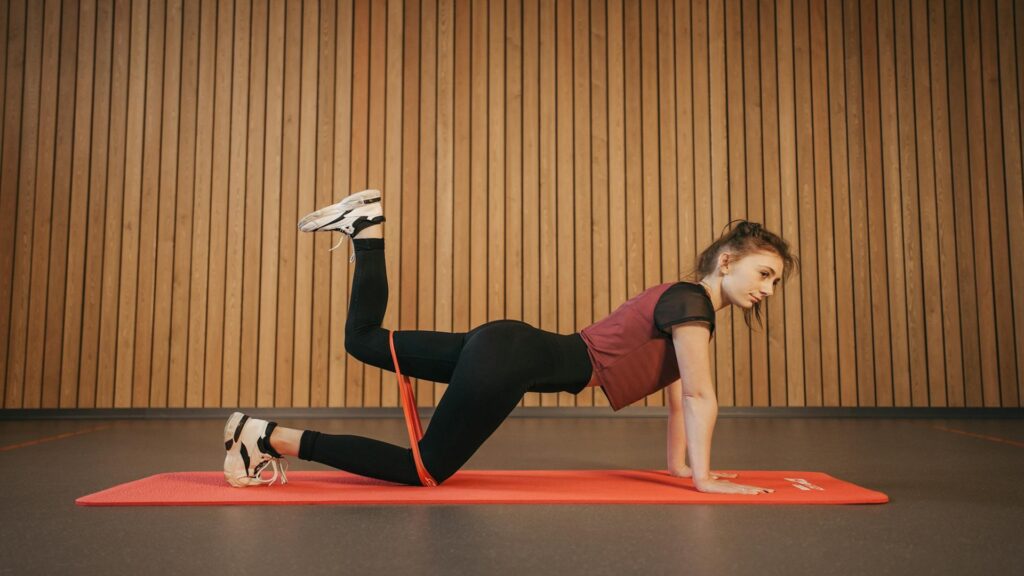
The donkey kick is executed on all fours: push your heel toward the ceiling with a bent knee while keeping your back straight and abs engaged. This is a staple for precisely targeting the gluteus maximus.
The fire hydrant, a variation of the donkey kick, involves raising the knee to the side at a 90-degree angle. It primarily targets the gluteus medius and the stabilizers of the pelvis.
Stability and Coordination Exercises
The lateral squat walk is performed in a half-squat position, taking sideways steps. It emphasizes the gluteus medius and the gluteus minimus. The muscle burn can be quite intense if repetitions are performed consecutively without interruption.
The single-leg Romanian deadlift completes this selection. Standing on one leg, push your hips back while leaning your torso forward and lifting the free leg straight behind you.
This movement targets the glutes and hamstrings while strengthening core stability.
A Comprehensive Glute Program to Try at Home
Three training formats cater to different profiles and objectives:
- Circuit Training (4 Rounds): 15 to 20 repetitions per movement, with 2 minutes of rest between each round. Alternate between squats, lateral walks, single-leg deadlifts, hip thrusts, reverse lunges, Bulgarian lunges, and donkey kicks.
- Tabata: 20 seconds of effort, 10 seconds of rest, for 4 to 6 rounds over 15 to 20 minutes. Ideal for combining cardio and toning.
- Bisets: 3 sets per pair of exercises, with 30 to 60 seconds of recovery. For example, sumo squat combined with lateral walk, unilateral hip thrust paired with the fire hydrant.
We recommend at least 2 to 3 sessions per week to achieve visible results. Differences typically become noticeable after around six weeks.
Each session should start with 5 to 10 minutes of cardiovascular warm-up and end with stretching to promote recovery.
Tips for Optimizing Your Glute Workouts at Home
Progressive overload is the foundational principle of any muscle development. Without it, the glutes quickly adapt, and progress stalls. Here are several concrete strategies to ensure continued progress:
- Gradually increase the number of repetitions per set.
- Integrate isometric contractions (hold the top position of the glute bridge for 20 seconds).
- Slow down the concentric phase to increase muscle tension.
- Reduce rest times between sets.
- Train unilaterally to intensify muscle engagement.
Simple accessories can add resistance without costly equipment.
A resistance band placed above the knees during squats or the glute bridge forces the push-out of the knees, further activating the glutes. A backpack filled with water bottles can substitute for weights when seeking to increase intensity.
Focusing on each contraction makes a significant difference. Feeling your glutes working with each repetition guarantees an effective workout.
A protein-rich diet further supports muscle development: without sufficient nutritional intake, muscle fibers struggle to rebuild.
Several factors influence results: session frequency, fitness level, genetics, age, and nutrition.
Beginners often progress more quickly than experienced practitioners since their bodies respond more intensely to new stimuli—a positive note for those just starting out.
Incorporating these glute exercises into a comprehensive program that includes cardio, muscle strengthening, and stretching is the winning formula for a balanced physique and enduring health.
