
The Numbers That Look in a Mirror
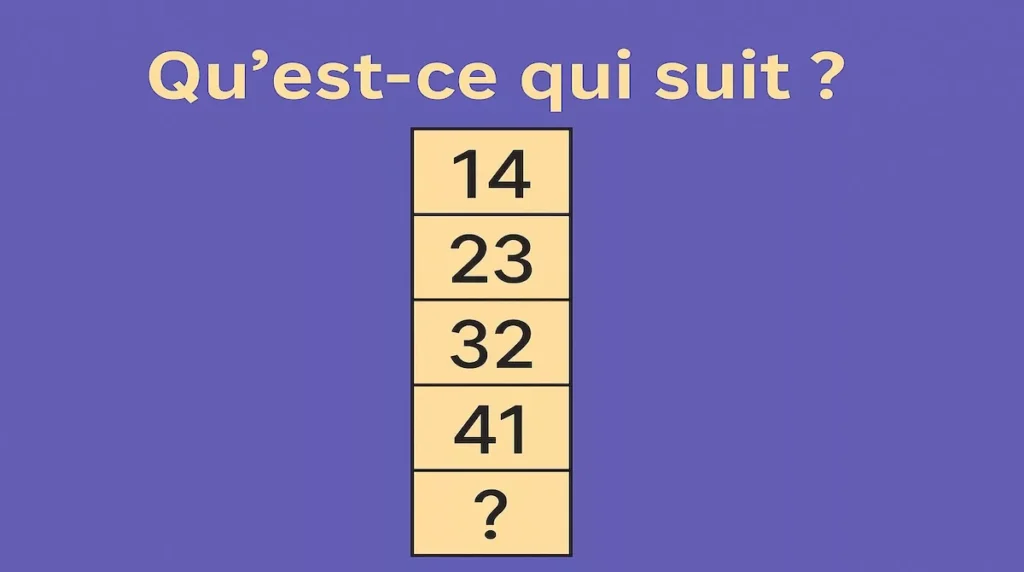
At first glance, this sequence seems very simple: 14, 23, 32, 41… One might immediately think it is just a regular addition, or perhaps a hidden formula. You grab your pencil, calculate the differences, but doubt begins to creep in. Why this logic when the numbers seem to glide from one position to another with a strange simplicity?
An Illusion of Simplicity
This is the trap of numerical puzzles: they always offer a first path, the most obvious one, which brings reassurance. However, this path is rarely the right one.
Here, the arithmetic progression is just a disguise. The numbers do not add up; they turn around. They move forward while changing their appearance.
The Dance of Numbers
Let’s take a closer look: 14 becomes 23. Then 23 transforms into 32. Next comes 41.
The numbers do not stack like bricks: they exchange places, they pivot, like dance partners. Each number contains the seed of the next, simply by reversing its positions. It is a discreet waltz, a mathematical mirror.
The Silent Lesson
An old math teacher would have loved this riddle. He would have written the sequence on the board and waited. His students, bent over their notebooks, would have tried all sorts of operations: subtractions, products, powers…
Some would spend whole minutes searching for a hidden algorithm.
Then he would smile gently and say:
“You are looking too far. The logic of numbers is not always in the equations; sometimes it lies in the perspective. Numbers love to play, to flip over, to disguise themselves. If you don’t know how to listen to them, they will always elude you.”
The Secret
The beauty of the puzzle lies not only in the number to find but in the journey to get there.
You need to observe, compare, test hypotheses, and accept that your initial intuition might be wrong.
Ready? If so, let’s move on to the solution we found…
Here is the solution we found:
Method 1 – By the Digits
We look separately at the tens digit and the units digit:
14 → 23
Tens: 1 → 2 (+1)
Units: 4 → 3 (−1)
23 → 32
Tens: 2 → 3 (+1)
Units: 3 → 2 (−1)
- 32 → 41
Tens: 3 → 4 (+1)
Units: 2 → 1 (−1)
The rule is therefore: at each step, add 1 to the tens digit and subtract 1 from the units digit.
Applying this again, we get: 41 → 50 (4+1, 1−1).
Method 2 – By the Differences
We can also see that each term increases by 9:
23 − 14 = 9
32 − 23 = 9
41 − 32 = 9
So the next term: 41 + 9 = 50.
In both approaches, the answer is 50.
If you enjoyed this challenge, make sure to take on more puzzles from our recommended reading section by clicking here.
