
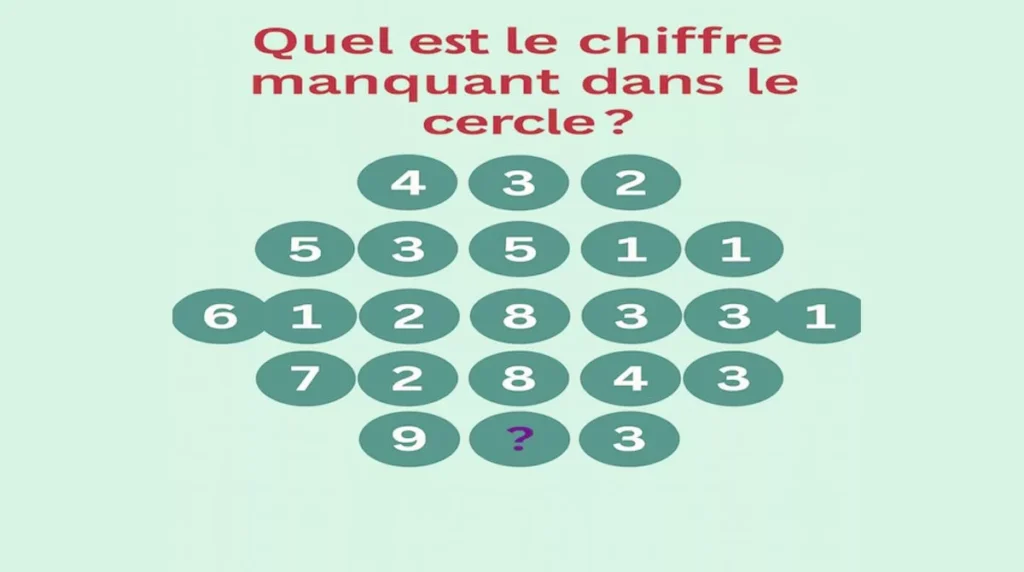
A new puzzle tests the skills of logic and mental calculation enthusiasts. It consists of numbered circles arranged in lines, one of which contains a question mark. The challenge is to deduce the missing number by identifying the rule that connects the digits.
An Easy-Looking Challenge That’s Deceptive
As is often the case with these types of brainteasers, the difficulty lies not in the complexity of the calculations but in the hidden logic.
The circles seem to follow a basic mathematical relationship, yet the misleading arrangement often leads many users to overthink or head in the wrong direction.
A Mobilized and Creative Community
Users have proposed various avenues, analyzed the numerical sequences, and shared their interpretations.
Some have adopted systematic approaches: cataloging the numbers, testing different operations, and comparing the lines with one another.
Others have taken a more intuitive approach, looking for visual patterns or repetitions.
While opinions may vary, everyone agrees on one point: the puzzle encourages us to step back and explore multiple hypotheses before arriving at the correct solution.
This diversity of approaches has made the publication a playful and stimulating exchange space.
Why Do These Types of Puzzles Appeal So Much?
Such brainteasers attract interest because they engage logic, mental agility, and the ability to spot hidden structures. They also encourage testing different strategies, which can be as gratifying as it is frustrating.
Beneath the exercise, it’s primarily the personal satisfaction of “unlocking” the logic that motivates participants, along with the joy of comparing their ideas with fellow puzzle enthusiasts.
It’s no surprise these puzzles enjoy such popularity: they fit seamlessly into the short formats of social media and foster interaction.
Users often return to check if they were correct, read new theories proposed, or simply to participate in the collective excitement.
The puzzle is a perfect example: a short, captivating challenge that’s subtle enough to hold attention.
Whether one finds the answer in seconds or after multiple attempts, the pleasure lies as much in the journey as in the final solution.
And given the enthusiasm it generates, this brainteaser will continue to keep minds engaged.
Is that good?
If so, let’s move on to the solution…
Here’s the Solution We Found
Hypothesis 1: Cross or Diagonal Sum
Let’s see if the numbers around the question mark can be connected through a sum or a logical operation.
Taking the numbers surrounding the question mark:
- Above: 2, 8, 4 (row 4)
- Still above: 1, 2, 8 (row 3)
- On the left and right: 9 and 3 (row 5)
Now let’s calculate the sum of these numbers:
- Row 4: 2 + 8 + 4 = 14
- Row 3: 1 + 2 + 8 = 11
- Row 5: 9 + 3 = 12
Total: 14 + 11 + 12 = 37
But this total doesn’t give us a direct clue. Let’s try another approach.
Hypothesis 2: Average or Difference
Let’s take the three numbers in row 5: 9, ?, 3
If we assume the missing number is the average of the two extremes:
(9 + 3)/2 = 6
The missing number could be 6.
Let’s test this logic on the other rows:
Row 1: 4, 3, 2 → average of 4 and 2 = 3
Row 2: 5, 3, 5, 1 → average of 5 and 1 = 3 (in the center)
Row 4: 7, 2, 8, 4 → average of 7 and 4 = 5.5 (but the center is 2 and 8)
So this logic works partially, but not everywhere.
Hypothesis 3: Symmetry
Let’s check if the structure is symmetric around the center:
Row 1: 4 3 2 → symmetry around 3
Row 2: 5 3 5 1 → imperfect symmetry
Row 3: 6 1 2 8 3 → no obvious symmetry
Row 4: 7 2 8 4 → 7 and 4, 2 and 8 → not symmetric
Row 5: 9 ? 3 → if we want symmetry, the missing number should be 6 to balance with the other rows
Conclusion
The most consistent logic appears to be that of the average of the extremes in row 5:
(9 + 3)/2 = 6
The missing number is likely: 6
