
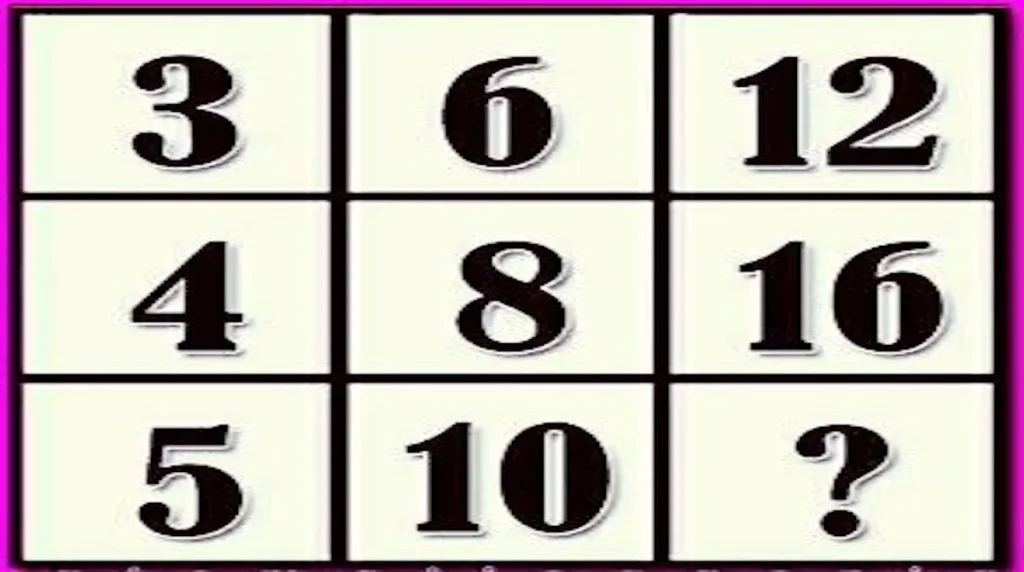
A Puzzle That Seems Easy
At first glance, this sequence of numbers appears simple: 3, 6, 12, 4, 8, 16, 5, 10, … A clear progression, almost mechanical. One might think they recognize a familiar pattern, an easy multiplication or addition. However, the attentive observer soon realizes that the logic is not uniform. Each series conceals its own rule, and the solution does not reveal itself to those who rush.
When Obviousness Becomes a Trap
Good puzzles have this power: they make us believe we have already grasped the concept. We multiply by 2, we double, we follow the rhythm… and we go astray. The key lies elsewhere.
A subtle variation from one segment to another completely alters the logic. The sequence is not merely a simple multiplication: it plays on a hidden motif, perceptible only to those who observe carefully.
More Than Just Numbers
This riddle does not only test your math skills. It primarily assesses your ability to notice patterns and to slow down.
The apparent repetition masks a subtlety: each number follows its own scheme. Understanding these motifs is like deciphering a small secret code.
A Lesson in Patience
It is said that an old logic professor loved to pose this type of problem to his students.
They often got lost in complicated calculations, convinced that they needed to apply the same rule to all the numbers.
But the professor smiled: he was not seeking speed, but rather attention to detail. The great discoverers, he said, are not those who find quickly, but those who can see what escapes others.
Your Turn to Play
The next number will not appear immediately. Analyze, compare, dare to hypothesize. The beauty of the riddle lies not only in the solution but in the journey.
Can you identify the rule that transforms 5, 10, … into the next number?
Here Is The Solution We Found:
Before suggesting a next number, observe the sequence: 3, 6, 12 — 4, 8, 16 — 5, 10, … Notice the pattern.
Each group of three numbers seems doubly linked: a simple motif repeats, but it changes with each trio. It is in this nuance that the true logic resides.
Step 1: Group the Numbers by Trios
We notice that the numbers seem to appear in groups of three:
3, 6, 12
4, 8, 16
5, 10, ?
Each trio appears to follow its own logic.
Step 2: Observe the Motif in Each Trio
Let’s look at the first two trios:
3 → 6 → 12
6 = 3 × 2
12 = 6 × 2
4 → 8 → 16
8 = 4 × 2
16 = 8 × 2
Thus, the rule for each trio seems to be multiplying by 2 at each step.
Step 3: Apply the Logic to the Third Trio
The third trio is: 5, 10, ?
- 10 = 5 × 2
- Therefore, the next number = 10 × 2 = 20
Step 4: Verification
Each trio follows the same logic: multiply by 2. The complete sequence thus becomes:
3, 6, 12, 4, 8, 16, 5, 10, 20
Observation Tip: The subtlety is that the sequence “jumps” to a new trio, increasing the first value of each trio by 1:
- 3 → 4 → 5
If you enjoyed this test, don’t forget to take on more challenges from our recommended reading section by clicking here.
