
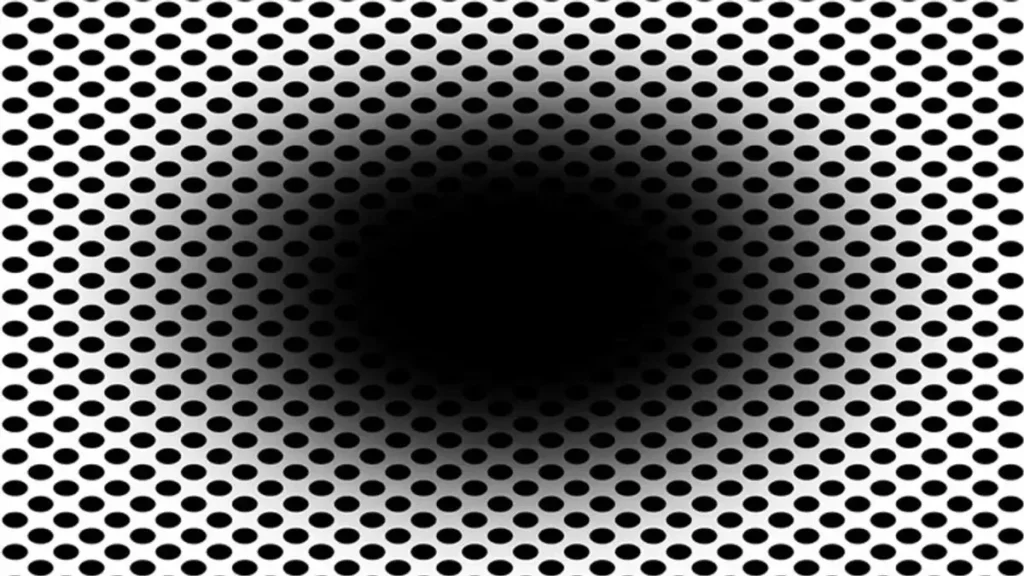
The illusion of the expanding hole
This optical illusion features a white background dotted with black points, at the center of which lies a blurred black spot. By fixating on this spot, one may perceive it as gradually enlarging.
An illusion that deceives the brain
Researchers from the University of Oslo, Norway, have demonstrated that the “expanding hole” illusion is so powerful that it tricks the brain into influencing the size of our pupils. They dilate as if the eye is preparing to enter a dark area.
Conversely, when the “hole” is colored instead of black, the phenomenon reverses: the pupils contract, as if the eye is adapting to brighter light.
Most Read Articles on Sain et Naturel:
- You know you were raised by good parents if you heard these 15 phrases while growing up.
- People who grew up without a strong father figure typically develop these 10 traits later in life.
- If these 10 phrases marked your childhood, you were raised by parents who never healed from their own traumas.
- 7 undeniable signs that you were raised by truly exceptional parents, according to psychology.
- 8 parenting rules that older generations followed, which the younger generations now see as harmful.
A dynamic illusion
According to Dr. Bruno Laeng, a professor in the Department of Psychology at the University of Oslo and the lead author of the study,
“The expanding hole is a highly dynamic illusion: the circular trail or the gradient of shadow from the central black hole creates a strong impression of optical flow, as if the observer is moving into a tunnel.”
The experiment conducted on 50 people
In their study, researchers showed the “expanding hole” image to 50 normally sighted individuals. Each participant was asked to evaluate the intensity of the perceived illusion, while the scientists measured their eye movements and the unconscious variations in their pupil sizes.
Results indicate that not everyone perceives the illusion the same way: approximately 14% of participants saw no expansion when the hole was black, and 20% did not recognize any particular effect when the hole was colored.
Moreover, the more intense the illusion was deemed, the more likely a participant’s pupil would dilate or contract. Conversely, those who did not perceive the illusion showed no pupillary changes.
A new understanding of visual perception
This study highlights the close link between perception and physiological response.
It suggests that pupil dilation and contraction depend not just on the actual light present in the environment, but also on light as it is perceived or even imagined.
As Dr. Bruno Laeng summarizes:
“Our results show that the pupillary reflex is not a simple automatic mechanism governed solely by light intensity. The eye adapts to perceived or even imagined light. Future research could reveal other physiological changes related to optical illusions, helping us better understand the workings of our perception.”
The study was published in: Frontiers in Human Neuroscience.
