
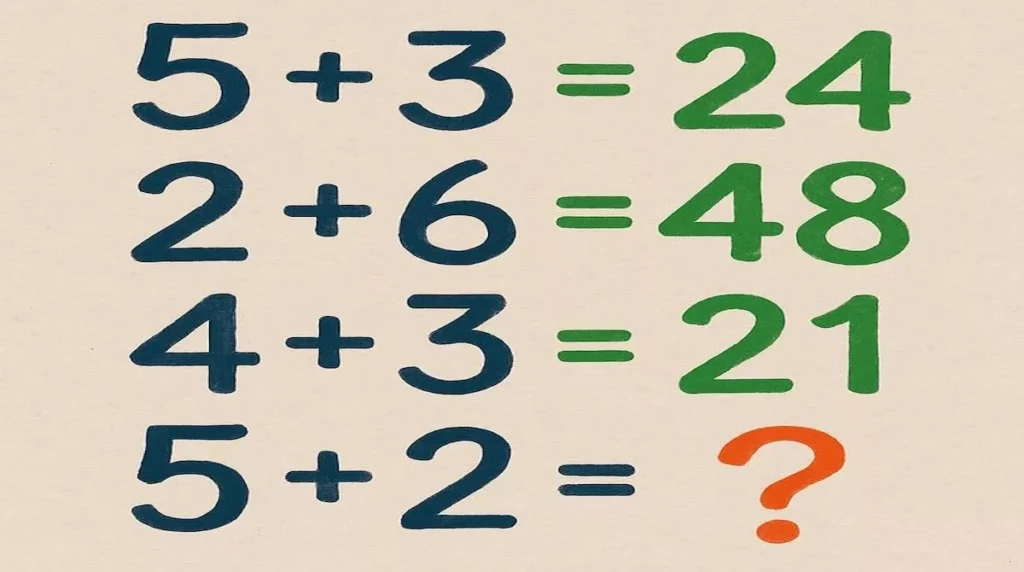
At first glance, these additions seem simple, almost trivial. Yet, the calculations are straightforward, and suddenly, our brains stumble. Where has the arithmetic logic we know gone? Why do these results not adhere to any classic rules?
The numbers here don’t merely add up. They play with us, inviting us to look beyond appearances.
We could attempt multiplications, powers, or convoluted combinations… But the answer does not lie in a complicated formula. It hides in the art of observing differently.
The Dance of Hypotheses
We might try adding squares, multiplying by mysterious coefficients, or searching for hidden patterns in the numbers.
But the beauty of the riddle lies elsewhere. It reminds us that curiosity is a skill: the more we exercise it, the more we perceive what others cannot see.
So, 5 + 2 = ? The answer is not just a simple number. It’s a revelation for those who know how to listen to the numbers.
The Mystery of Numbers
An old math teacher used to say: “Numbers are not just symbols. They are riddles to be decrypted, doors to unsuspected logics.”
He would write these equations on the board and then sit in silence, watching his students fidget. Some sought sophisticated calculations, others obvious patterns… But only those who dared to question the obvious found the key.
What if the solution was not in the result but in the way we construct it?
The Ultimate Challenge
The true treasure lies not in the solution itself but in the art of questioning. Numbers are not adversaries to conquer, but patient guides. They whisper to us: “Look at me differently. Listen to what I’m not saying.”
So, can you decode the test? Can you see what others overlook?
The answer is right there, before your eyes… It simply requires a change of perspective.
Here is the solution we found:
1) Observe the Examples and Propose a Simple Pattern
We have three equalities:
- 5 + 3 = 24
- 2 + 6 = 48
- 4 + 3 = 21
Let’s look at the sum and then multiply by the second term:
- 5 + 3 = 8, then 8 × 3 = 24.
- 2 + 6 = 8, then 8 × 6 = 48.
- 4 + 3 = 7, then 7 × 3 = 21.
So a pattern that fits all the examples is:
(a + b) × b
(we add a and b, and then multiply the total by b).
2) Equivalent Algebraic Expression
(a + b) × b = a × b + b²
(same formula, just rearranged).
3) Verification
This pattern explains all the given equalities without exception.
4) Application to 5 + 2 — Complete Breakdown
- Addition: 5 + 2 = 7.
- Multiplication: 7 × 2 = 14.
Thus, 5 + 2 = 14 according to the pattern (a + b) × b.
Answer:
14
5) Final Remark
The compact formula is:
f(a, b) = b × (a + b) = a × b + b².
If you enjoyed this test, don’t forget to take on other tests or challenges from our recommended reading section by clicking here.
