
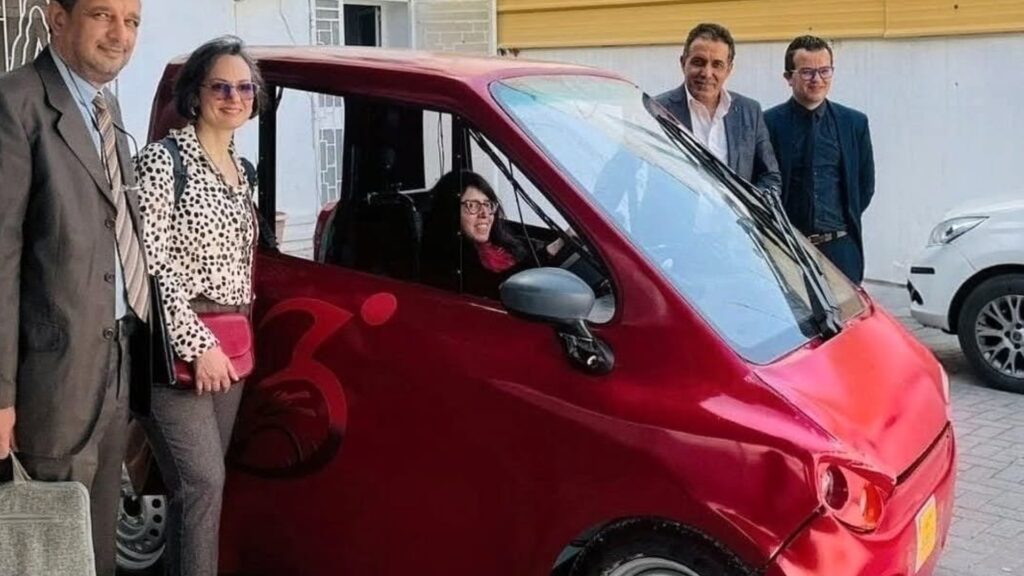
For most, actions like opening a car door, sliding into the driver’s seat, and pressing the accelerator or clutch pedal come naturally, almost instinctive. But for those with mobility challenges, the experience is dramatically different. Driving becomes an intricate puzzle that demands modifications to the vehicle and careful planning. Enter Khadija Jallouli, a young Tunisian woman who uses a wheelchair. She has designed an electric vehicle that is both accessible and inclusive, addressing the shortcomings of public transportation.
Could freedom begin with a car door?
The statistics are alarming: in the Paris metro, only 29 of 303 stations are accessible to people with mobility impairments, and that number dwindles further when elevators are out of service. Nationwide, a mere 47% of bus stops are designed to ensure safety and facilitate access to seating.
For those often described as “society’s forgotten,” public spaces can feel like a minefield—an open-air dystopia. What appears to be a simple movement for the able-bodied can transform into an arduous challenge for those with disabilities.
Khadija Jallouli has faced these challenges countless times, with her electric wheelchair frequently bumping against curbs and uneven surfaces. A twenty-minute journey for most may take her nearly triple or quadruple that time. But this empathetic woman, known for her radiant smile, doesn’t subscribe to a defeatist mindset. Instead, she believes that every problem has a solution. She prefers to think of “obstacles” as “challenges.”
Realizing that society can be slow to adapt its spaces with compassion and foresight, Khadija, an entrepreneur at heart, set out to create an innovative vehicle designed specifically for individuals with disabilities. What began as an idealistic concept has become a tangible reality.
See this post on Instagram
When a personal project becomes a public utility
Unlike traditional automotive designers who draft blueprints from the comfort of an office, Khadija Jallouli’s journey began with her lived experiences. A novice in the automotive industry but a master of resilience, she drew from her own encounters to refine the vehicle’s design, focusing on creating a more hospitable and ergonomic experience. With the determination of someone fueled by purpose, Khadija has developed a groundbreaking car that stands out as a technical feat. Through her company, “Hawkar,” what was once a mere prototype has evolved into a proposition rich in human value.
The vehicle, resembling a cheerful carriage for its users, features an innovative rear opening that functions as a single door. Inside, the wheelchair transitions seamlessly into the driver’s seat, integrating with the floor. Steering is managed via a joystick that replaces traditional pedals, allowing for controlled driving. It also includes an integrated handle to minimize sudden movements and make maneuvering feel more intuitive.
This fully electric car boasts a dashboard displaying real-time information for practical purposes. Yet, its standout feature—a design that allows it to park perpendicular to the sidewalk—offers a smooth exit and fluid mobility. While car enthusiasts may view it as a toy, to those who need it, it symbolizes a profound revolution, paving the way to independence.
Improving everyday life for wheelchair users: a driving force
As a champion of inclusivity, Khadija Jallouli is also a pioneer. She stands as the first woman in Africa to commercialize this electric vehicle, which is among the most advanced in terms of accessibility. She epitomizes a spirit that refuses to let obstacles dictate one’s journey. Through her electric car, she isn’t just introducing a new mode of transportation; she is re-centering mobility in the fight for autonomy.
Through Hawkar, Khadija advocates for a new way of conceptualizing automobiles. A vehicle should not only prioritize speed or distance; it should empower individuals to choose their destination and navigate their journeys with ease.
Her story serves as a reminder that innovation can originate not from grand laboratories or corporate offices, but from the simple act of confronting barriers. Sometimes, it merely requires a fresh perspective on these obstacles to reveal the start of a new path.
Khadija Jallouli has not merely envisioned an electric vehicle; she has transformed the challenges of her journey into fuel for progress. Her wheelchair hasn’t distanced her from the road; instead, it has given her a unique vantage point to see the twists, turns, and detours of life in a new light.
