
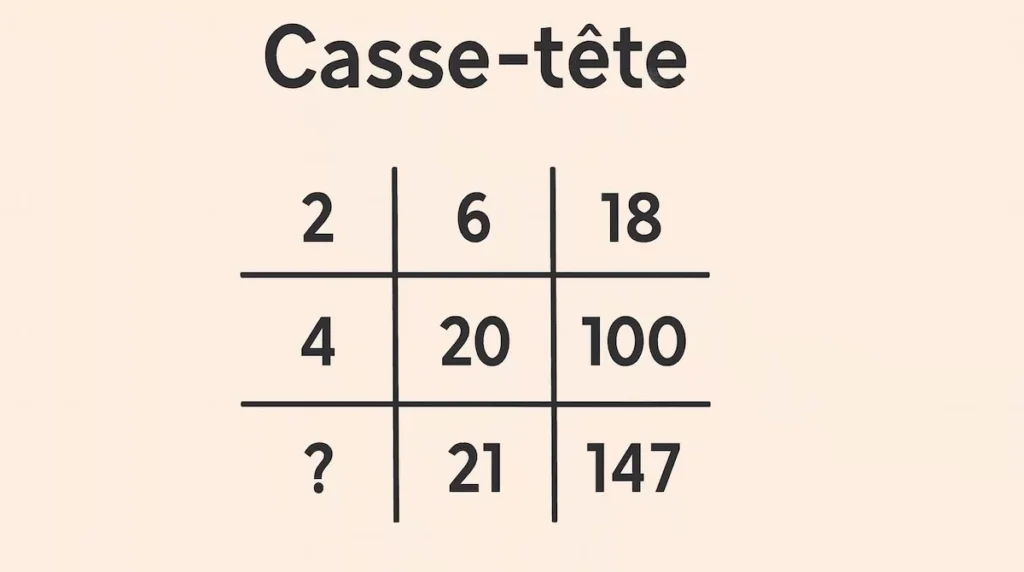
Puzzles are small challenges that engage our logic and observational skills. This particular one involves finding a missing number in a grid, a task that is both simple and stimulating for the mind. Although the numbers are arranged in rows and columns, the key lies in how they interact with one another.
The original post included the caption: “Number puzzle. Use your intelligence to find the solution.” It quickly captured the attention of users eager for logical challenges.
An Enigma That Captivated Internet Users
Since its appearance online, users have been competing with ingenuity to solve the puzzle, suggesting different methods to identify the missing number.
Here are some examples of the responses shared:
“2 × 3 = 6 and 6 × 3 = 18. 4 × 5 = 20 and 20 × 5 = 100. 3 × 7 = 21 and 21 × 3 = 147. The answer is 3,” explains one user.
Another reasoning goes: “6² = 36 ÷ 2 = 18. 20² = 400 ÷ 4 = 100. 21² = 441 ÷ 147 = 3.”
A third, more visual approach states: “In the first row, the numbers are multiplied by 3, in the second by 5, and in the third by 7. Since the numbers in the left column are 1 less than the constant multipliers, my answer is 6.”
Finally, another user simplifies it: “3. Because in the first row, the series numbers are multiplied by 3, in the second by 5, and in the third by 7.”
These responses highlight how a single puzzle can inspire multiple perspectives and analyses of numbers, depending on one’s viewpoint.
The Logic Behind The Puzzle
To solve this type of puzzle, one must identify the pattern that connects the numbers.
By closely observing the relationship between the first number and the final results, one can deduce the missing number. This is a classic example of reasoning through patterns and relationships between digits.
Puzzles are not just entertaining; they also stimulate our memory, concentration, and ability to recognize patterns. Studies have shown that regularly solving such problems can enhance cognitive functions and may even slow down age-related mental decline.
A Little Anecdote While We Wait
Did you know that in the 19th century, the famous French mathematician Édouard Lucas, inventor of the Fibonacci sequence, hosted puzzle competitions during private dinners in Paris?
His guests were tasked with solving numerical enigmas, often based on squares or multiplications of numbers. Those who failed had to… tell a math joke to redeem themselves! A fun way to combine humor with logical reasoning.
This seemingly simple puzzle illustrates how observation and logic can uncover unexpected solutions.
Whether you’re a math enthusiast or just curious, these puzzles provide an excellent way to stimulate the mind and enjoy some playful moments.
Sounds good? If so, let’s move on to the solution…
Here Is The Solution We Found
Step 1: Observe The Relationships
Let’s look at each line.
We are searching for a pattern or relationship between the numbers in each row.
Step 2: Check The Multiplications
First row:
2 × 3 = 6
6 × 3 = 18
Thus, here, each number is multiplied by 3 to reach the next one.
Second row:
4 × 5 = 20
20 × 5 = 100
Here, the multiplier is 5.
Third row:
We have 21 and 147.
21 × 7 = 147
So the multiplier for this row is 7.
Step 3: Go Backwards To Find The Missing Number
For the third row, we know:
? x ? = 21
We assume the pattern is the same as the previous rows: the first number × the multiplier = the second number.
Here, the multiplier for the third row is 3 (or 7?). Let’s verify:
Following the same pattern as the other rows:
- First row: ×3 then ×3
- Second row: ×5 then ×5
- Third row: ×? then ×?
Examining the relationship: 21 → 147 = ×7
So, the first number × 7 = 21? No, 21 ÷ 7 = 3
Thus, the missing number is 3.
Step 4: Verification
- Third row: 3 → 21 → 147
- 3 × 7 = 21
- 21 × 7 = 147 Perfect!
Conclusion
The missing number is 3.
Before you go, explore other brain teasers to stimulate your mind by clicking here.
