
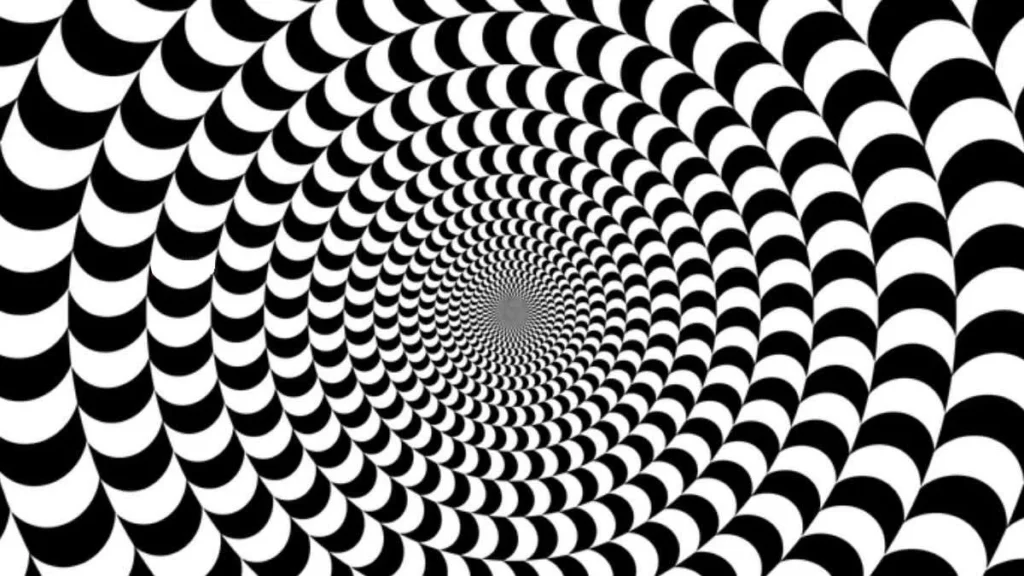
Test your keen eyesight with this geometric optical illusion
Put your keen eye to the test with this geometric optical illusion challenge! A number is hidden among swirling black and white patterns that trick your brain into perceiving movement. Only those with exceptional visual perception can spot it in under five seconds. Ready to prove your observational skills?
An optical illusion is a visual phenomenon where our perception differs from objective reality. In this case, it’s a geometric distortion illusion: the arrangement of lines creates a wavy effect in black and white that gives an illusion of depth or rotation, although the image itself is perfectly static.
These illusions occur when the brain attempts to interpret complex patterns, contrasts, or spatial arrangements.
Our visual system relies on context clues, contour detection, and assumptions about depth and light, which can lead to misinterpretations.
The Challenge: Find the Hidden Number in the Image
Geometric optical illusions are often used in art, psychology, and neuroscience to study visual perception and brain function. They demonstrate that vision depends not only on what our eyes see but also on how our brain interprets the information.
Today’s illusion is based on a clever composition: a radial pattern that seems to swirl around a center. Although the image is still, it appears to vibrate, move, or distort. The thickness and curvature of the lines enhance this sense of movement.
Your mission: discover the hidden number in this optical illusion in less than five seconds.
Set your phone’s timer…
Are you ready? Observe closely!
3… 2… 1… Stop!
Time’s up!
Did you find the number?
Congratulations to those who spotted it in a flash: you have outstanding visual acuity and an observational skill set worthy of a true detective!
The Solution to the Geometric Optical Illusion
So, what was the hidden number in this illusion?
The number concealed among the patterns is 169.
If you didn’t see it right away, don’t be discouraged!
These visual illusions require practice. The more you train yourself to solve these types of puzzles, the more you’ll enhance your observational skills, analytical abilities, and speed of perception.
Continue to take on these visual challenges by clicking here; they are not only fun and stimulating but also beneficial for your brain.
