
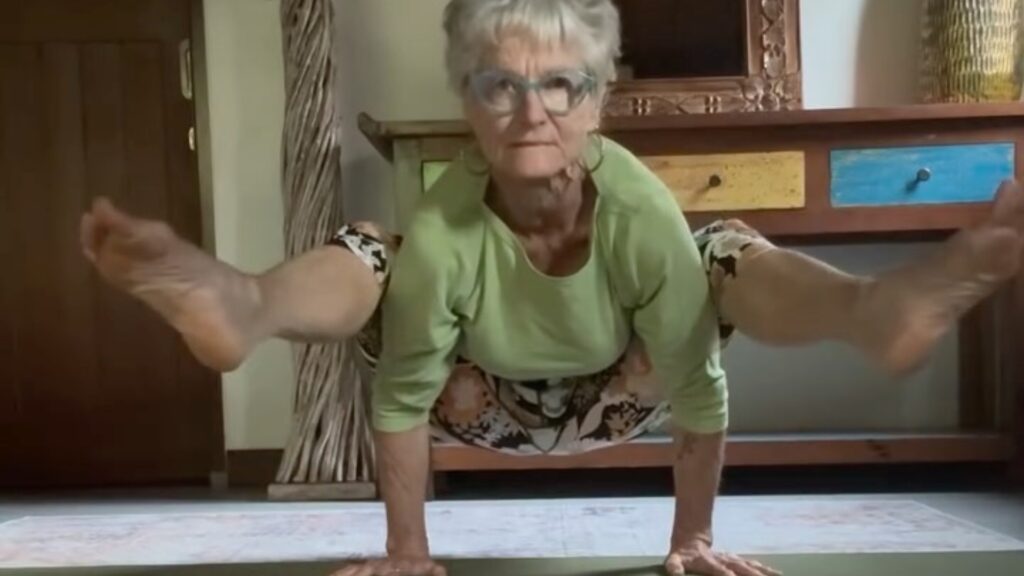
While many 20-somethings complain about back pain and creaky joints, this 77-year-old grandmother effortlessly twists and bends into impressive yoga poses. She doesn’t just go through the motions of basic stretches; she contorts herself in ways that seem to defy gravity—upside down, legs stretching towards the sky, or suspended in unusual postures. This Australian woman transforms public spaces into vast yoga mats, sending a powerful message: growing older doesn’t mean fading away, giving up, or being relegated to a life viewed from a sitting position.
A senior turning age on its head
On her Instagram account, @ageingdisgracefully_, Kaye Cleave does more than post selfies and document her day like many influencers. She balances on railings, uses park benches for support, improvises street acrobatics, and turns every piece of urban furniture into a workout accessory.
Watching her in motion, it’s easy to forget her age; however, Kaye isn’t striving to appear younger. She doesn’t manipulate the passage of time or turn her body into a time machine. Instead, she showcases what her body is still capable of achieving.
For her, aging does not equate to becoming sad, bored, or inactive. This philosophy starkly contrasts with the often anxiety-inducing portrayals of aging. For Kaye, wrinkles don’t signal withdrawal; they accompany a vibrant woman who continues to move, dance, meditate, and push her own boundaries.
View this post on Instagram
Fun fact: she didn’t always live like an athlete
Perhaps the most reassuring aspect of Kaye’s journey is that she didn’t spend her entire life in a gym diligently maintaining her muscle mass. As a child, she practiced dance and acrobatics, but as an adult, that athletic routine faded. For years, she did not engage in regular exercise and openly admits to not always leading a pristine lifestyle. It wasn’t until she reached her fifties that she reassessed her priorities and committed to being active again, primarily through yoga and meditation.
This adds an even more uplifting dimension to her message. Kaye does not embody the guilt-inducing notion that one must have “maintained their body” since adolescence to expect to “age well.” On the contrary, she advocates a much gentler philosophy: it’s never too late to start moving again and discover the untapped capabilities of one’s body.
She walks, swims, rides her bike regularly, dances once a week, and practices yoga approximately every other day. There’s no military schedule or an alarm set for 5 a.m. to squeeze in a hundred squats before breakfast. Her primary rule can be summarized in a few words: listen to your body. Some days it craves movement; on others, it asks for rest.
View this post on Instagram
Aging without waging war on your body
In an era where anti-aging campaigns proliferate online, aiming to reverse the natural course of biology, Kaye Cleave takes a refreshing stance against ageism. She does not appear to be desperately chasing youth or fighting a battle against time.
Her message is more “pro-aging” than anti-aging; it’s a philosophy unto itself. She does not aim to halt the passage of years; instead, she seeks to live fully as those years pass. This is a crucial distinction in a society where aging, particularly for women, is often synonymous with doom, and the age written on one’s identification feels much like a stamped expiration date.
Kaye does not demand her body return to that of a 25-year-old; instead, she learns to appreciate the body she has today. This attentiveness to sensations also allows her to contextualize performance appropriately. While her impressive poses may inspire, they should not become an unrealistic standard for other seniors. Not everyone can or should be upside down at 70. Healthy aging can take myriad forms: walking for a few minutes, maintaining mobility, dancing in the living room, or simply continuing an activity that inspires a daily desire to rise in the morning.
A different perspective on the passing years
While Kaye Cleave may not hold the universal key to longevity, and her physical state cannot serve as a benchmark for all seniors, her story offers a critical representation of aging—a portrayal that does not feel like punishment or a waiting room. Through her remarkable poses, she reminds us that the body can continue to surprise, learn, and bring joy long after reaching the age that marketing campaigns discreetly label “mature.” In truth, Kaye is not trying to prove she is still young; she is showcasing how being older can also be a very vibrant way to exist in the world.
When she finds herself upside down, legs in the air, and a smile on her face, Kaye might just be overturning more than her own body—she flips, for a brief moment, the pervasive stereotypes we hold about aging.
