
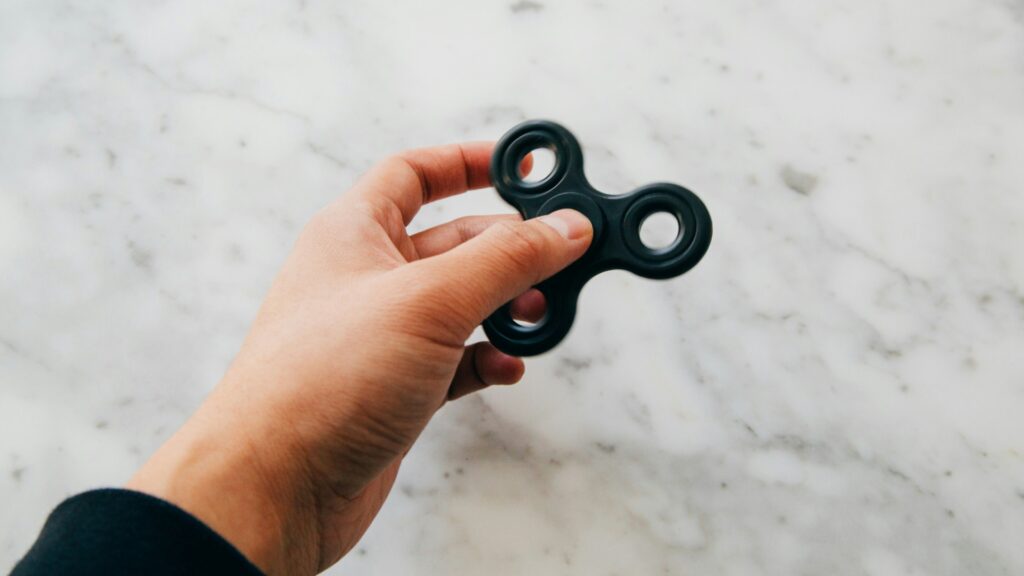
No matter the situation, you may find yourself with an almost compulsive need to fill the void between your fingers. You might absentmindedly bring them to your mouth, crack your knuckles, or twirl a strand of hair. In moments of extreme urgency, you might even find yourself performing tricks with a pencil like a majorette. Your hands are hyperactive, always in search of distraction—and these habits are far from trivial.
Distraction for Focus: The Power of Engaging Hands
Back in school, we crafted paper airplanes, tapped pens rhythmically on our desks, and fiddled with the caps of our markers. We would doodle aimlessly in our notebooks or fill empty squares with blue ink. Our hands were always on the move.
As adults, that restlessness persists. Just look at the rise of stress balls, DIY slime kits, hand spinners, and spiky rings. We might crumple the collar of a blouse during meetings, scribble without intention on a sticky note, or fidget with a necklace chain like a cat batting at a ball of yarn. While these gestures may be dismissed as signs of boredom or distraction, they can actually help channel our thoughts and increase our mental availability.
“When we move and engage in activities, we change our brain’s neurochemistry in the same way a medication might,” explains Kelly Lambert, a neuroscientist at the University of Richmond, in an interview with CBS News. In other words, keeping our hands busy creates a sense of control.
Keeping Hands Busy for a Calmer Mind
In the 19th century, physicians already recommended knitting to women struggling with anxiety. This past-time has endured, even in an era dominated by smartphones. “It may seem simplistic, but repetitive movements boost the production of certain neurotransmitters. And when you create something—a hat or a scarf—you derive satisfaction from it,” says Lambert.
It’s no coincidence that more and more people are digging in the dirt, unspooling yarn, signing up for pottery classes, and following art tutorials. In an age where many jobs are sedentary, with hands simply tapping away at keyboards, creative activities that treat our fingers as instruments are seeing a resurgence. “When you create something—be it painting, cooking, or assembling objects—you engage both hands in a more creative manner, which is more stimulating for the brain,” she adds.
Hands-On Activities: Evocative Examples
To arrive at these conclusions, the researcher observed similar behaviors in rodents. Animals that had to dig and activate their paws to find food displayed better mental health compared to their “privileged” counterparts, who were spared this task. “When we take an animal in perfect harmony with its environment and simply provide it with rewards without any effort, its stress hormone levels rise significantly—it loses all its benefits,” she elaborates. This situation can be easily translated to the human experience.
Whether it’s wiping down furniture while doing household chores, attempting to replicate a pattern discovered online with a needle, or filling in the gaps of a coloring book, the outcome remains the same. These activities, whether leading to a handcrafted creation or serving as a meditative practice, soothe the mind. Thus, hands aren’t solely meant for tapping away on a phone. When employed wisely, they can fulfill your quest for inner peace.
The next time your fingers start to fidget for no apparent reason, remember this insight. These gestures, far from being futile, serve as a natural method to care for your brain and well-being. It’s not a lack of attention; it’s a protective mechanism, an often misunderstood form of meditation.
