
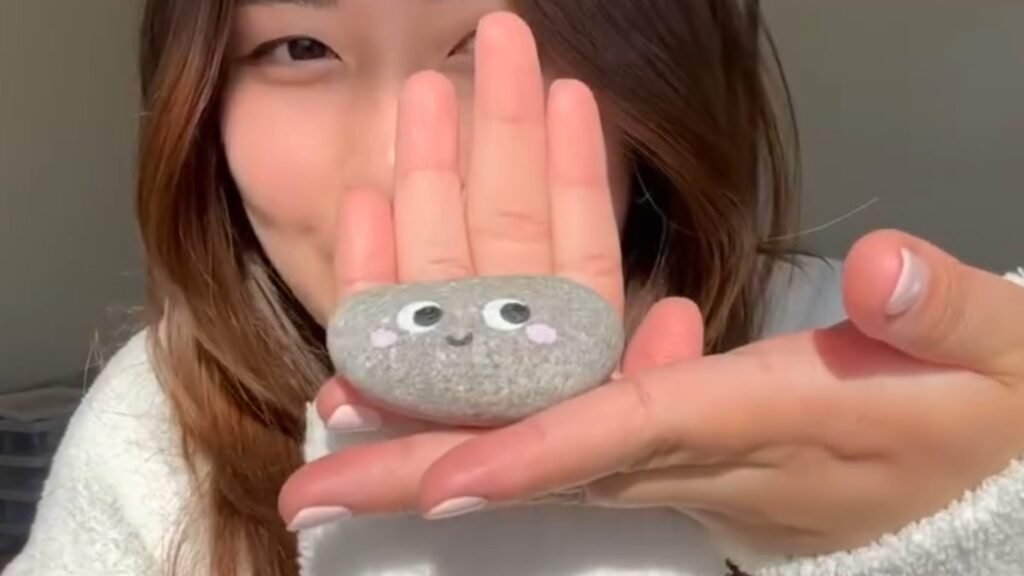
In a world where South Korean workers find themselves glued to their computers all day long, it isn’t a steaming cup of coffee that offers them solace, but rather a quirky trend: the “companion rock.” This anthropomorphized stone, complete with slanted eyes and a warm smile, occupies a place of honor on their desks. In a country where social isolation poses serious challenges, this little piece of rock becomes a unique source of comfort, bravely defying the pervasive loneliness that many experience.
A Pocket Friend Carved from Stone
These rocks exude charm with their endearing eyes, delightful faces, and a surplus of kindness. They fit snugly in the hand, make no noise, and sport a solid surface, yet fulfill a tender role. There’s no need to overthink: the answer lies in the unexpected. Enter the companion rock, crafted to evoke a sense of presence amidst the impersonal and self-centered atmosphere of open-plan offices or corporate skyscrapers.
These companion rocks, reminiscent of characters from a Miyazaki animated film, are not mere desk ornaments like a pencil holder. They fill the void of office spaces just as cement fills cracks, but more importantly, they work to heal the deep wounds of solitude. There’s no need to take them out for walks at dawn, indulge them with premium snacks, or rearrange one’s home in their honor. Less demanding and energy-consuming than living pets, they serve a similar emotional purpose, acting as a more rustic version of the nostalgic Tamagotchi; a remedy for a lack of attention and affection.
In these Asian countries, some of which even have a Ministry of Loneliness, individuals have little time to devote to a traditional pet. Therefore, responsible and practical citizens choose the companion rock. While it may be small in size, it occupies a significant place in its owner’s life. This unassuming stone underpins the fragile support structures of well-being for many South Koreans.
The Companion Rock: A Bulwark Against Loneliness
To the uninitiated, it’s just a stone—an ordinary piece of nature, a mineral object lacking any particular significance. Its only apparent mission seems to be evoking memories of vacations. However, for South Koreans, this personified pebble acts as a confidant, a source of strength during tough times, and a pocket therapy. For just a handful of Won, they can purchase their designated rock, customize it, and create a cozy dwelling—sometimes even more lavish than Barbie’s dream house.
Complete with straw hats, sunglasses, and various accessories designed to imbue character, these companion rocks have become the cornerstone of happiness in contemporary Korea, enjoying a remarkable rise in popularity. On the Chinese social platform Xiaohongshu, over 70,000 posts feature these rocks, portraying their royal lifestyle. They reside in cozy nests much like babies in cradles and pose against breathtaking backdrops, showing off while their fellow rocks suffer the afflictions of tourist foot traffic. Douyin, the Chinese equivalent of TikTok, boasts ten million views related to these companion rocks, underscoring their purpose.
But how did such a simple stone turn into a tangible version of the elusive imaginary friend? The story began in the United States in the 1970s when Gary Dahl famously marketed charming rocks that could captivate even the most serious adults. In South Korea, where work-life balance is often a myth and employees frequently live to work, these companion rocks naturally found their niche.
A Rock That Reveals the Harshness of Life in Korea
In South Korea, the work culture is intense, with employees sometimes living at their workplaces. The standard 40-hour workweek can burgeon to 52 hours or more, with overtime considered standard practice. What may be viewed as exploitation elsewhere is legally accepted here. High performance is not optional; it’s a national principle ingrained from a young age. In contrast to France, where employees are eager to dash out at five o’clock, South Koreans can often be found toiling well into the night.
In this environment, the companion rock emerges as a surprisingly well-suited companion: it demands nothing, raises no inquiries, and never calls in sick. It patiently waits on the desk, unfazed by video conferencing, spreadsheets, and the long hours that stretch into the night. While the concept seems lighthearted, it symbolizes the heavy burden of productivity pressures.
The companion rock may evoke laughter, but it also tells a profound story about our era. It reflects the realities of individuals surrounded by screens—constantly connected, yet at times profoundly lonely. Ultimately, this rock serves as a powerful reminder of the solitude that permeates contemporary life.
