
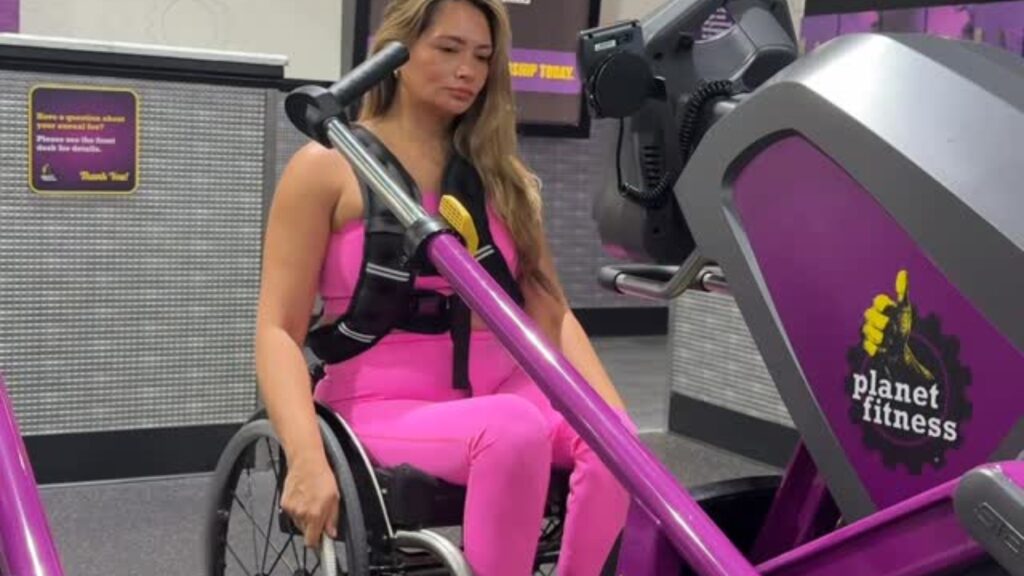
For wheelchair users, public spaces often resemble an obstacle course, fraught with challenges. Boarding a bus, navigating curbs, entering shops—actions that seem effortless for those labeled as able-bodied become formidable tasks for individuals with reduced mobility. Urban infrastructures typically lack compatibility with this mobility device, which is designed for diverse terrains. However, some gyms are responding to this reality by offering adaptable machines tailored for what some may call the “invisible” members of society. The video shared by @thejourneyofabravewoman proves there is a glimmer of hope.
Gyms Are Becoming More Inclusive
Crossing a street, navigating subway stairs, or even opening a door may appear trivial for those who can walk. It’s a formality requiring minimal effort, sometimes just a quick breath.
In contrast, for individuals reliant on wheelchairs, these everyday activities transform into physically taxing journeys filled with hurdles. Each daily outing becomes a lesson in patience and adaptation. For those with disabilities, whether congenital or acquired through accidents, traveling from one point to another can take three times longer. According to data from APF France Handicap, 90% of wheelchair users face daily challenges while navigating urban environments.
However, some venues are actively adapting to enhance accessibility and foster inclusivity—an ideal that should be standard, not optional. A leading example is content creator @thejourneyofabravewoman, who showcases the positive changes in her gym. For her, the wheelchair has become an extension of herself, allowing her to engage with an elliptical-like machine without needing to transfer out of her chair.
She can easily unscrew the original seat and position herself in front of the equipment without the need for excessive maneuvering. While this might seem trivial to some, for her, it symbolizes the beginning of a better world—one that embraces differences rather than rejecting them.
See this post on Instagram
Staying Active Despite Disability: A Means of Self-Celebration
The common perception is that a disability signals the end of leisure activities, relegating individuals to a sedentary lifestyle. For this vibrant young woman, who embodies the saying, “where there’s a will, there’s a way,” such notions have never resonated. A free spirit and a nomad at heart, her disability has never been a hindrance, although the layout of streets, buildings, shops, and transport systems has often caused her frustration and derailed her plans.
Therefore, when she notices improvements, no matter how small, she can do nothing but appreciate them. This gym machine isn’t a revolution, but it is a welcomed progress. When the young woman, known in real life as Marcela Marañon, doesn’t have access to such privileges, she tirelessly seeks solutions to satisfy her thirst for adventure and excitement.
A prolific author of practical travel guides for individuals with disabilities, she champions locations designed for mobility impairments. Whether parasailing above the heights of Dallas or zip-lining over the vast forests of Costa Rica, she advocates for equal opportunities. As she reflects on her thrilling experiences and some disappointing realities, she emphasizes that disability should never act as a barrier, especially not one that is perceived as prohibitive.
An Invitation to Rethink Public Spaces
This accessible gym machine serves as a reminder that the challenge often lies not with the wheelchair itself, but within the surrounding environment. A gym that offers adaptable equipment enables more individuals to engage in fitness without having to navigate a treacherous path between machines or request special accommodations.
This approach should extend far beyond the walls of gyms. Sidewalks, public transportation, restaurants, hotels, and stores should be usable without needing to anticipate every obstacle. A curb that is too high, a door that is too heavy, or only a few centimeters too little clearance can transform an ordinary outing into a daunting expedition.
Marcela doesn’t ask for special treatment. Instead, she demonstrates that spaces designed for diverse bodies benefit everyone. A ramp can assist a wheelchair user as well as a parent with a stroller. An automatic door makes it easier for both someone with a mobility issue and someone loaded with bags to enter.
Ultimately, through her videos, Marcela not only showcases what a wheelchair user can achieve; she illustrates all that could be accomplished if her surroundings no longer posed hindrances.
