
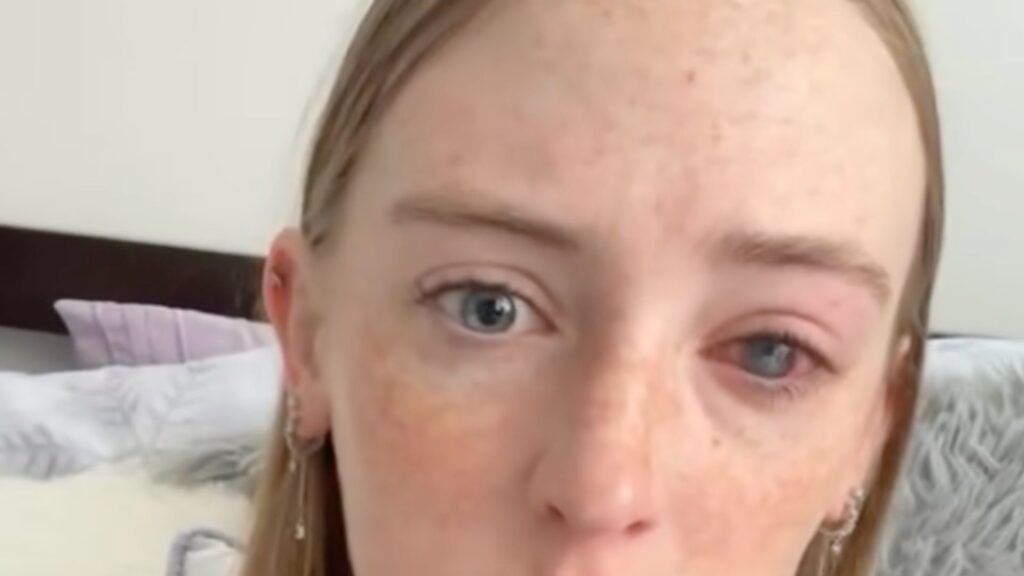
In what seems like an ordinary routine, a simple shower led to an extraordinary life change for 20-year-old Grace Jamison, an American on vacation in the Dominican Republic. Her story, which went viral on social media, raises an alarming question that many contact lens users never consider.
A Shower with Contacts: A Devastating Infection
While staying in the Dominican Republic, Grace washed her hair while wearing her contact lenses. Unfortunately, the local tap water, which was poorly purified, contained a microscopic parasite known as Acanthamoeba. This organism became trapped between her contact lens and cornea, leading to a severe infection called Acanthamoeba keratitis.
The Acanthamoeba parasite is found in tap water, lakes, swimming pools, dust, and even soil. Contact lenses can create microscopic scratches on the eye’s surface, often invisible to the naked eye, allowing the parasite to infiltrate between the lens and the cornea with just a trace of contaminated water. The Contact Lens Society of America emphasizes that “contact lenses are medical devices, and following hygiene practices—especially avoiding contact with water during showers, swimming, or sleeping—is essential for their proper use.”
See this post on Instagram
A Misdiagnosis that Compounded the Issue
Upon returning to the United States several weeks later, Grace sought help from an optometrist, who mistakenly failed to identify the infection and prescribed her steroid eye drops—a treatment that was contraindicated for her condition. A week later, she lost her sight, remaining blind for about two months until she received appropriate treatment. This unfortunate delay in diagnosis is all too common for this condition, often overlooked even by healthcare professionals.
A Long and Painful Treatment Journey
Acanthamoeba keratitis is particularly challenging to treat. Grace explains that she has to administer eye drops every half hour to an hour. She describes excruciating pain radiating throughout her head, extreme sensitivity to light, and difficulties sleeping.
Raising Awareness Among Millions of Contact Lens Users
Since her diagnosis, Grace has utilized her social media platforms to raise awareness. She urges contact lens wearers to avoid showering, swimming, or sleeping with their lenses, to wash their hands before handling them, and to always refresh the solution for storing lenses with each use. Her story has sparked a wave of reactions from individuals shocked that they were never informed by their optometrist.
See this post on Instagram
In conclusion, Grace Jamison’s experience underscores the dangers of seemingly innocuous actions and their potential irreversible consequences. Wearing contact lenses requires strict adherence to hygiene guidelines—some of which remain alarmingly under-discussed. It is a straightforward message, yet one that could save lives.
