
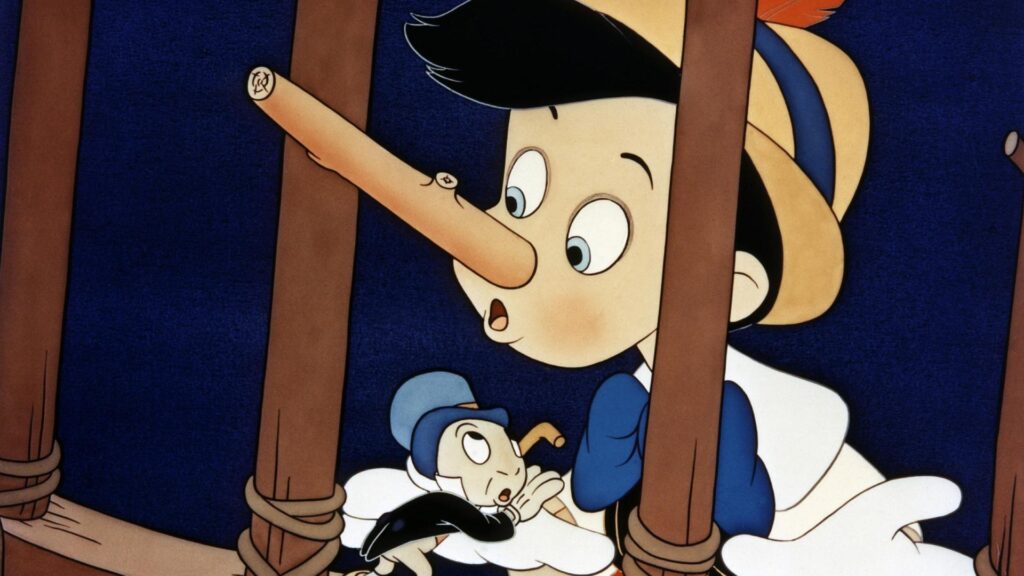
In the realm of body language, various physical cues can betray a lie, but there is an even more telling sign to detect fabrications. The next time you question the honesty of someone’s statements, take a glance at their nose. This prominent feature of the face is an excellent detector of deception, a phenomenon scientists have dubbed the “Pinocchio Effect.” You likely don’t need an explanation; after all, you’re familiar with the story of the little wooden boy.
The Pinocchio Effect: What Is It?
You surely remember the iconic tale that chronicles the adventures of Pinocchio, the living puppet created by Geppetto. This little boy with a disjointed body and bark-like skin has a unique trait: whenever he lies or bends the truth, his nose elongates like a branch nourished by fertilizer. It becomes impossible for him to manipulate his words or enhance reality without facing the consequences, donning a disproportionately large nose that can bear the weight of an entire forest. His lies are as visible as his nose in the middle of his face, and not merely figuratively.
This fable by Carlo Collodi, later adapted by Disney, is not as trivial as it may seem. The author of Pinocchio set out to entertain children and lull them to sleep but inadvertently depicted a scientific phenomenon through his imagination. Researchers from the University of Granada in Spain have pursued this line of thinking, turning Pinocchio into a case study of sorts.
According to their studies, during instances of deception or bluffing, the nose undergoes subtle changes. While it doesn’t literally grow in size—otherwise, we’d all have trunks in its place—it does swell slightly and redden at its tip, along the sides, and at the bridge near the eyes. This physiological response garnered its own name: the Pinocchio Effect.
The Science Behind This Curious Phenomenon
The researchers didn’t rely solely on intuition to reach this enlightening conclusion. They utilized thermal cameras to observe the bodies of willing deceivers. This tool captures real-time temperature variations that are invisible to the naked eye. The images clearly show that the nose appears redder than the rest of the face. Contrary to Pinocchio, who suffers from a well-chosen magical curse, humans are subject to the laws of biology.
This “Pinocchio Effect,” which enables the uncovering of lies and the revealing of potential impostors, is attributed to decreased activity in the insula, a brain region responsible for consciousness, the reward system, and the regulation of body temperature. It’s like an internal thermostat flipping an alert switch: the mouth may say falsehoods, but the body reveals the truth.
When the Body Speaks Louder Than Words
The Pinocchio Effect extends beyond merely swelling or reddening of the nose; it is part of a broader array of physiological micro-reactions that occur alongside lying. Sweating, pupil dilation, changes in heart rate, and muscle tension are all indicators that the body activates when attempting to conceal the truth.
The nose serves as an involuntary visual signal. Increased blood flow caused by the stress of lying leads to localized redness and sometimes slight swelling. While subtle, the effect is detectable with thermal cameras or by an observer trained to interpret these signals. In essence, the body betrays what the mouth seeks to hide.
Thus, the Pinocchio Effect illustrates the intricate workings of the human body. Just as cheeks flush with embarrassment and lips tighten with desire, the nose is particularly sensitive to deceit, ultimately exposing its owner. Interestingly, Disney cartoons have almost morphed into a compendium of medical references. Between Cinderella complex and Tinkerbell syndrome, the standout characters of our childhood lend their names to various human conditions.
