
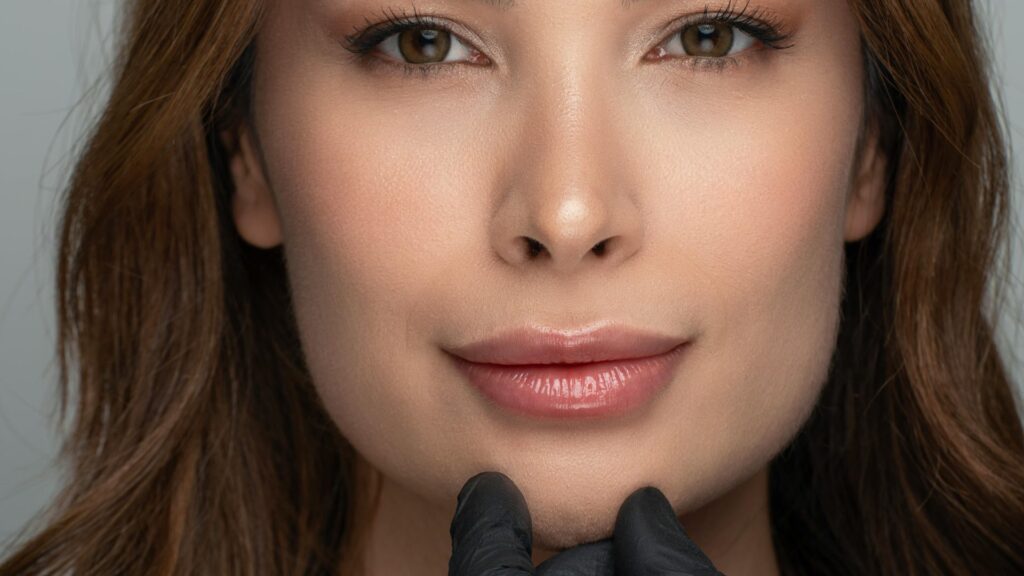
A new term is making waves on social media: the “lip filler accent.” Behind this somewhat enigmatic phrase lies a straightforward idea: could the shape of your lips partially influence the way you speak? This topic intrigues and divides, straddling the line between science, perception, and cultural trends.
A Way of Speaking Linked to Lip Shape
The “lip filler accent” refers to a distinct way of articulating certain sounds, which some associate with plumper lips—often the result of cosmetic procedures. Journalist Alex Sujong Laughlin, who has explored this phenomenon, suggests that altering the volume of the lips might influence pronunciation. This is due to the space between the lips, teeth, and tongue playing a crucial role in sound formation.
Speech specialists confirm that lips are essential for producing certain sounds, particularly bilabial consonants like “p,” “b,” and “m.” Therefore, even a slight change in their position or volume could, in theory, alter how these sounds are produced. However, each individual is unique. Just like your lips, your voice contributes to your personal signature, with its distinct features shaping your way of speaking.
A Phenomenon Amplified by Pop Culture
Although the term has gained traction recently, it owes much of its popularity to social media. Viral videos have highlighted this speech style, often associating it with certain pop culture figures and highly visible aesthetic standards that have emerged since the 2010s.
With the rise of online content, trends related to appearance are no longer confined to visuals; they also influence how people express themselves. Particular voices, intonations, or ways of articulating can become recognizable—and occasionally mimicked. Media outlets like The Cut have discussed the possible connection between aesthetic transformations and perceptions of diction. In other words, what you see can affect what you hear.
Speaking: A Delicate Mechanism
Beyond trends, speaking is a delicate balance of various bodily elements: the lips, of course, but also the tongue, palate, and even breath. Lips play a particularly vital role in articulating certain sounds; thus, changes in their shape or volume can subtly impact diction.
However, this is never an isolated factor. The way you speak depends on an overall coordination unique to each individual. Your voice, rhythm, and inherent or acquired accent tell a story that is uniquely yours.
Between Scientific Reality and Social Perception
The “lip filler accent” is not a clearly established scientific phenomenon. For some experts, it encompasses both perception and physiology. The way people speak can evolve based on social environments, media models, and cultural dynamics. You may unconsciously adopt intonations or speech patterns inspired by individuals you frequently see or hear.
Sociolinguistic research indicates that such shifts can spread quickly, especially in the social media era. What is identified as an “accent” can thus be a blend of cultural trend and anatomical reality.
Body, Expression, and Freedom
The interest in the “lip filler accent” reflects a broader trend: an increasing focus on appearance and its influences on other aspects of daily life, including voice and expression. Today, aesthetic transformations are a common practice worldwide. They are part of a diversity of personal choices tied to how each individual relates to their own body.
Crucially, your body, voice, and means of expression are yours alone. Whether you choose to undergo cosmetic modifications or retain your original diction, there is no single “right” way to speak.
Ultimately, the “lip filler accent” is primarily a topic of discussion at the intersection of science and culture. It serves as a reminder that your uniqueness—both in appearance and voice—constitutes your richness.
