
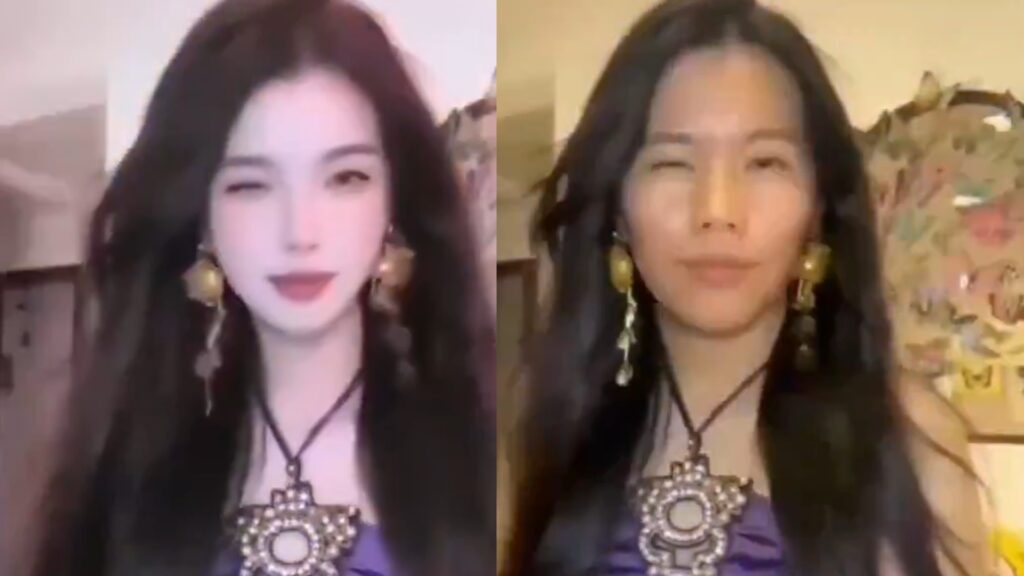
A scene that initially circulated on Chinese social media has now captured the attention of audiences worldwide: an Asian streamer had her true face revealed during a live broadcast due to a sudden malfunction of the beauty filter she used. In just a few seconds, this influencer, who typically showcased a “filtered” appearance, stunned her followers with a drastically different visage, leading to a mix of shock and mockery.
When reality catches up to the virtual
The glitch occurred during a live session on Douyin, the Chinese version of TikTok, according to several sources, including the New York Post and Yahoo Entertainment. Clips shared on X (formerly Twitter) captured the shocking moment the filter deactivated, revealing a face that bore little resemblance to the image her fans had come to know.
A Chinese female streamer reportedly lost 140,000 followers after the beauty filter she was using suddenly malfunctioned during a live stream and revealed her real face 😶 pic.twitter.com/AvlC8fC2JG
— Clown World ™ 🤡 (@ClownWorld) February 16, 2026
An accidental catfish sparks online division
The incident quickly prompted a wave of reactions. Some users accused the streamer of engaging in “catfishing”—a deliberate deception regarding her appearance. Hundreds of mocking comments flooded social media, and reports indicate that she lost nearly 140,000 followers in just a few days, although this figure has yet to be verified.
However, not everyone joined the ranks of critics. Some internet users defended the influencer, stating, “Even if she misrepresents her appearance, she looks much prettier without the filter,” commented one user. Others highlighted the immense aesthetic pressure faced by influencers in China, where digital perfection has become the norm.
The obsession with filters: a widespread phenomenon
The widespread use of “beautifying” filters across Asian platforms has been a topic of debate for several years. In 2019, another streamer known by the pseudonym “Your Highness Qiao Biluo” created a stir when she appeared without her “magical” filters, revealing herself to be a middle-aged woman behind an avatar of a “young digital goddess.”
These incidents illuminate the increasingly blurred lines between digital imagery and reality. As technology enables people to reshape their faces at will, issues of transparency, authenticity, and even mental health become critical concerns, both for influencers and their audiences.
This incident serves as a stark reminder of how “virtual beauty” can morph into a prison. While some may view it as merely a story of an illusion shattered, others emphasize the essential awareness that lies behind every “filtered” face: a person who often bears the weight of immense pressure to please and thrive in a world where appearance matters more than ever.
