
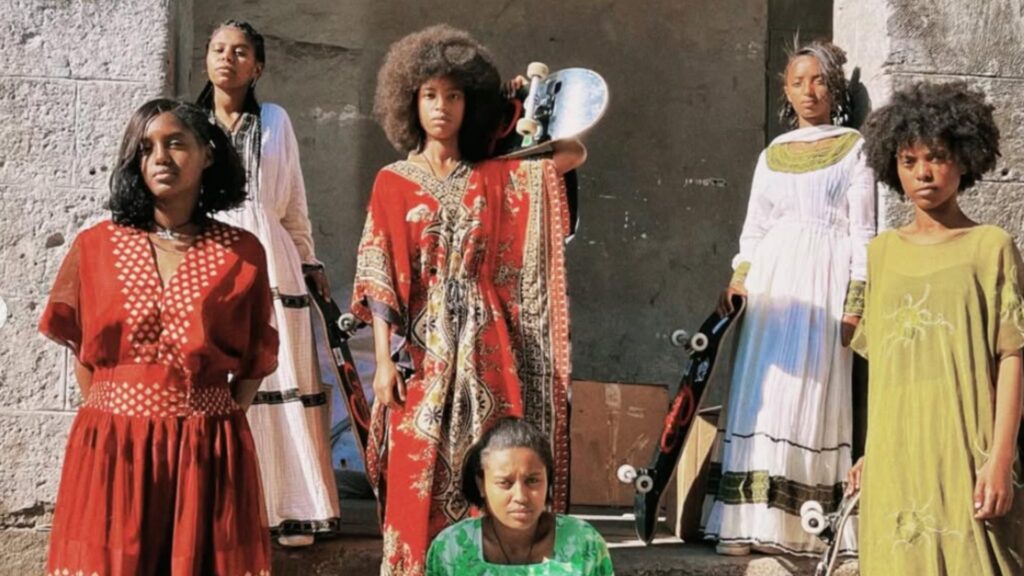
In the bustling streets of Addis Ababa, a group of young women is transforming concrete into a space of empowerment. On their skateboards, they carve out a new trajectory, challenging gender norms in a society where public spaces remain predominantly male. Addis Girls Skate is not just a collective; it is a rolling manifesto, a bold statement against traditions that restrict women’s freedoms.
Skateboarding brings a breath of fresh air to Ethiopian pavement
Skateboarding officially arrived in Ethiopia in 2016 with the opening of the first skatepark in the capital. Until then, it was often marginalized as a pastime reserved for expatriates, swiftly gaining traction among boys. However, girls had to fight for their place on the board.
“You’re dishonoring your family!” was a common refrain directed at Edomawit Ashebir and her peers. Yet, these critiques never stifled their determination. For them, gliding across the pavement is more than just a sport; it is a means of claiming their right to exist in public spaces, a way to reclaim their city. Each trick and jump becomes an act of resistance against patriarchy and societal expectations.
View this post on Instagram
A sanctuary of freedom every Saturday
Every Saturday morning, the skatepark is exclusively reserved for them. For a few hours, they escape from familial and societal constraints, with skateboards underfoot, sometimes donning traditional white habesha kemis, other times opting for comfortable baggy pants and sneakers.
Makdelina Desta, co-founder of the Addis Girls Skate collective, encapsulates this unique feeling: “On my board, I am myself, free from imposed roles.” For Lydia, another skater, “The sound of the wheels clears my mind. I no longer hear the criticisms or the disapproving looks.” Whether attempting an ollie or cruising down a ramp at the Merkato market, these young women are reinventing their daily lives, twist by twist, with audacity and newfound confidence.
View this post on Instagram
Solidarity and support in a judging world
While disapproving looks are still frequent, the skaters find a safe haven at the skatepark. Tsion recalls an incident when a passerby called her a “devil” while waiting for her to fall. Yet, the community behind the ramps is vastly different: girls and boys freely share tips and boards, building a camaraderie that transcends prejudice. In a country where many women often fade from the public sphere post-marriage, these interactions foster a genuine network of encouragement and inspiration.
View this post on Instagram
Burtekan, the icon of all generations
Burtekan, affectionately nicknamed “Mamy,” is a 43-year-old single mother who stands as an emblematic figure of the movement. Despite the mockery regarding her age, she continues to ride alongside the teenagers: “I’m not dead yet. I still have things to experience.” Her presence serves as a testament that no stage in life should mandate withdrawal or invisibility. For the younger generation, she symbolizes the potential to reclaim one’s life, regardless of social constraints.
Shred the patriarchy: a global perspective
Swiss photographer Chantal Pinzi has documented these female skaters in her project “Shred the Patriarchy,” gathering girls from countries as varied as Morocco, India, and Ethiopia. According to her, skateboarding teaches resilience: falling, getting back up, and trying again. In Hawassa, she supports Shurrube, the only skater in her town, by bringing her recycled boards from Berlin. These gestures illustrate that the courage and determination of these girls transcend borders and cultures.
View this post on Instagram
Life lessons on wheels
Skateboarding is more than just a sport; it is a school of life. Thanks to Ethiopian Girl Skaters, founded by Sosina Challa, young girls receive academic and emotional support. As Edomawit succinctly states: “I’ve stopped listening to those who say it’s not meant for us. Now, I ride.”
Each trick accomplished by these Ethiopian girls breaks barriers, overturns stereotypes. With hair blowing in the wind and determined stares, their free-spirited performances embody a generation that rejects constraints. In Addis Ababa, the sound of wheels on concrete is no longer merely an urban noise; it is the melody of rediscovered freedom and rewritten destinies. These skaters demonstrate that daring to be oneself, even in a conservative context, can transform a city—and perhaps the world—one board at a time.
