
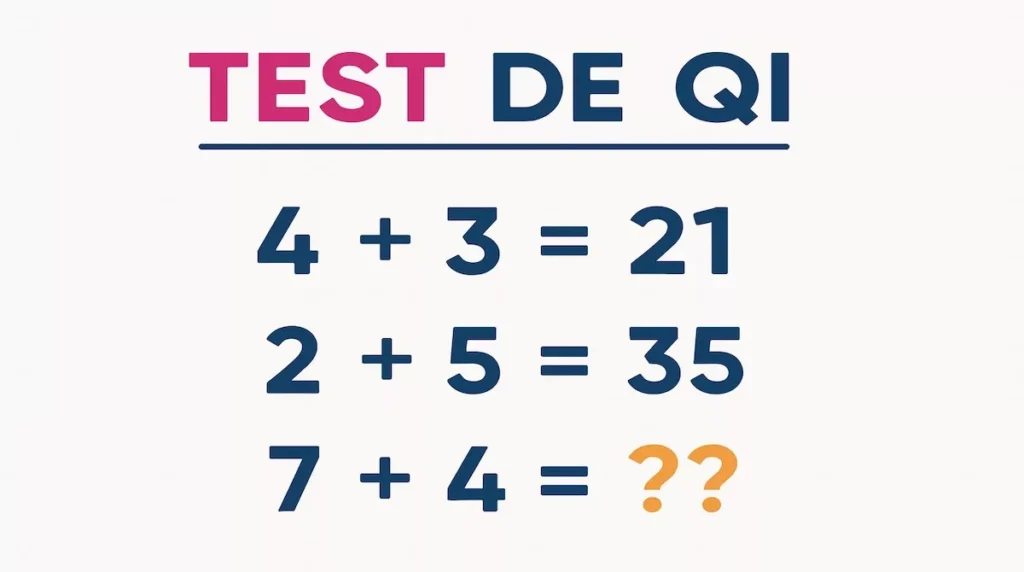
A fascinating mathematical puzzle
A new mathematical riddle is likely to pique the interest of puzzle enthusiasts. Presented as a challenge accessible only to those skilled at tackling problems, this riddle tests participants’ logical reasoning abilities and creativity.
Theories and reflections
Many puzzle aficionados have delved into this type of riddle, each proposing different methods to find solutions.
Some have explored unconventional operations, such as multiplying the two numbers and then adding one of them, while others have employed approaches based on sequences or hidden patterns.
This variety of attempts demonstrates how a simple riddle can stimulate analytical thinking and imagination. It also highlights that solving problems doesn’t always rely on traditional methods.
At first glance, these equations may seem illogical, prompting a different line of thinking to uncover the solution.
The challenge seems simple at first glance, but it conceals a logic
A playful way to stimulate the brain
Solving riddles like this comes with several cognitive benefits. They promote critical thinking, strengthen working memory, and encourage considering solutions from different angles.
Even if the solution isn’t found immediately, the reflective process activates areas of the brain essential for analysis and creativity.
In addition to enhancing cognitive skills, these challenges offer moments of distraction and intellectual satisfaction. They can be integrated into educational activities or simply serve as stimulating entertainment.
A challenge for everyone
Whether you’re passionate about mathematics or just curious to test your reasoning abilities, this type of riddle makes for excellent mental exercise.
The interest lies not only in the solution but also in the journey that leads to its discovery.
This particular riddle illustrates that with a bit of patience and reflection, it is possible to move beyond conventional approaches and adopt a new perspective on seemingly simple problems.
Here is the solution we found:
Observe the given equations and note that they do not follow standard addition.
4 + 3 = 21
2 + 5 = 35
Look for a pattern or hidden rule that connects the numbers.
Test the hypothesis that the result could be obtained by multiplying the two numbers and then adding the first number:
For 4 + 3: (4 × 3) + 3 = 12 + 9 → here, 12 + 9 = 21 matches the provided result.
For 2 + 5: (2 × 5) + 5 = 10 + 25 → 35, which also matches.
Apply this rule to the third equation: 7 + 4
Calculation: (7 × 4) + 7 = 28 + 28 = 56
Conclude that the answer to the riddle is 56.
And before you go, explore more games and tests by clicking here.
