
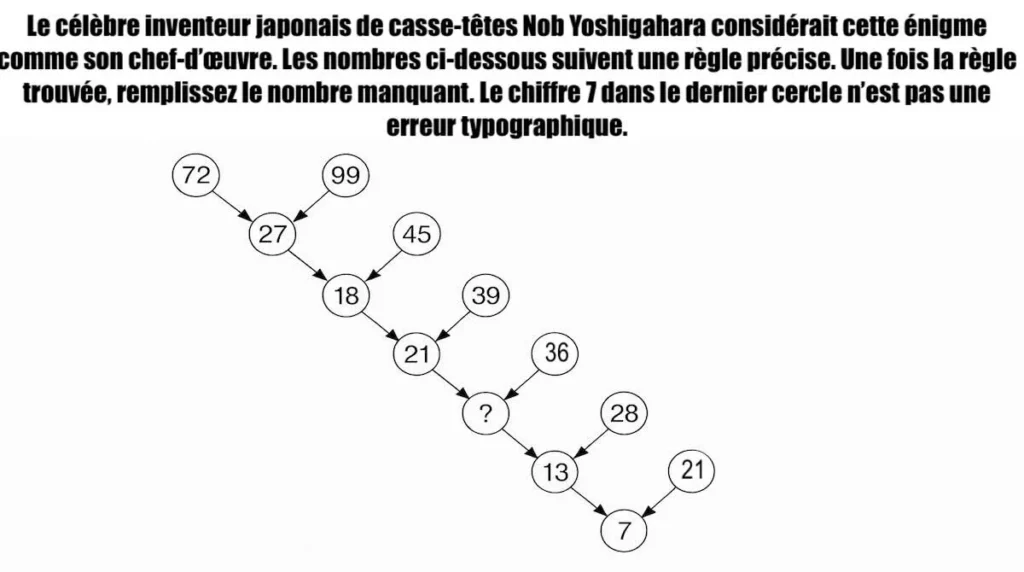
This fun puzzle challenges you to find a specific pattern in order to solve it. Can you uncover its mystery? Riddles and puzzles are perfect for stimulating the brain and facing new challenges. For instance, Reddit is a platform where you can find a multitude of brain games to enjoy for hours.
The Riddle Shared on Reddit
A user recently shared a riddle on the subreddit r/puzzles. The objective was to find the missing number in an image accompanied by the following text:
“Nob Yoshigahara, a Japanese puzzle inventor, regarded this puzzle as his masterpiece. The numbers below are arranged according to a precise rule.
Once the rule is understood, find the missing number. The number seven in the last circle is not a typo.”
The image was published with the caption: “I couldn’t figure it out.” The challenge was thus to identify the exact pattern and determine the missing number.
This puzzle, shared a while ago, quickly gained traction on social media.
User Reactions
Users proposed various interpretations to solve the riddle. One early comment explained: “The mistake lies in assuming you have to calculate the difference between the two numbers. In reality, you need to add the digits of the two numbers above. 2 + 1 + 3 + 6 = 12.”
Another user added: “The principle is that it seems universal until the last element. It sets up a fairly obvious pattern and then suddenly subverts it. You have to look beyond the first impression.
This is what makes the game interesting and not just a random riddle of the type ‘guess which operation it is’.”
A third user commented: “Subtracting seemed too complicated, so I didn’t even try. My lazy brain first checked simple addition.”
Finally, a fourth user provided a detailed explanation: “Try going from top to bottom following the arrows. But add the figures of the two preceding numbers to get the next indicated number. 1 + 3 + 2 + 1 = 7.”
Why This Riddle Fascinates
This riddle attracts attention because it combines a clear pattern with a surprising last element.
It pushes players to think beyond initial impressions and test different hypotheses.
This blend of apparent simplicity and final subtlety is what makes this Japanese puzzle so captivating.
If this is satisfactory, let’s move on to the answer.
Here is the solution we found:
Column 1: 72 → 18 → 36 → 13
- 72 ÷ 4 = 18
- 18 × 2 = 36
- 36 – 23 = 13
Column 2: 27 → 45 → ? → 7
- 27 + 18 = 45
- 45 – ? = ?
- ? – ? = 7 → We’ll come back to this
Column 3: 99 → 39 → 28 → 21
- 99 – 60 = 39
- 39 – 11 = 28
- 28 – 7 = 21
Looking for a Horizontal Logic
Row 1: 72, 27, 99
- 72 + 27 = 99
Row 2: 18 + 45 = 63, but 63 ≠ 39
- Apparent Inconsistency
Row 3: 36 + ? = 28 → ? = -8
- No Logic
Row 4: 13 + 7 = 20, but ≠ 21
The Secret Is Diagonal and Transformational
Let’s look at the transformations between the rows:
From Row 1 to Row 2:
- 72 → 18 = 72 ÷ 4
- 27 → 45 = 27 + 18
- 99 → 39 = 99 – 60
From Row 2 to Row 3:
- 18 → 36 = 18 × 2
- 45 → ?
- 39 → 28 = 39 – 11
From Row 3 to Row 4:
- 36 → 13 = 36 – 23
- ? → 7
- 28 → 21 = 28 – 7
Deduction of the Missing Number
Let’s focus on the central column:
- Row 2: 45
- Row 4: 7
You’ll notice that:
- 45 – 38 = 7
Therefore, the missing number must be 38 in order for:
- 45 – 38 = 7
Conclusion
The missing number in the center of the challenge is: 38
Before you go, explore more brain games and tests to get to know yourself better or to stimulate your mind by clicking here.
