
The Mystery of Hidden Numbers: When Logic Hides Where You Least Expect It
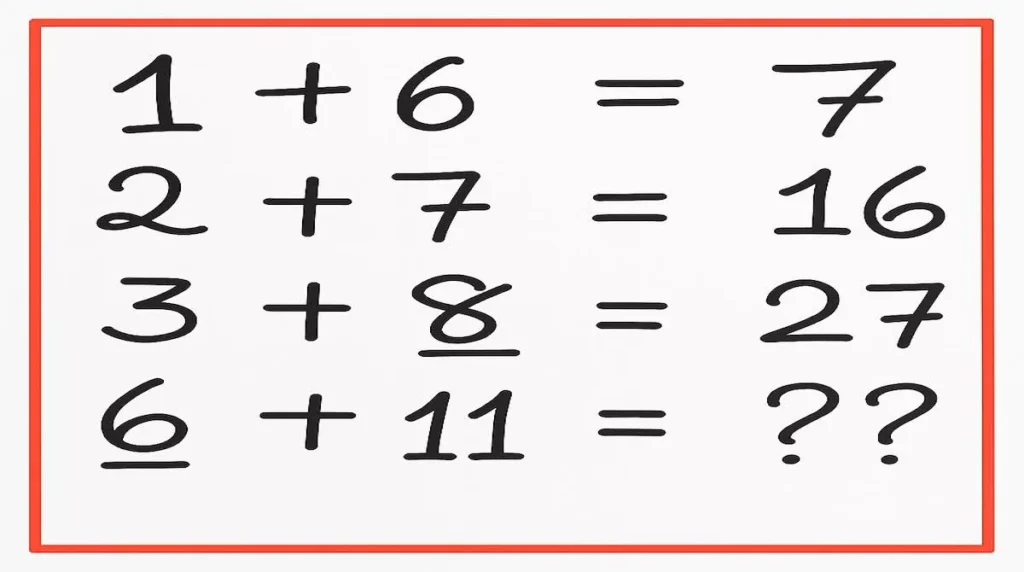
Imagine for a moment: you’re sitting at your desk, pen in hand, staring at a series of additions that seem to defy the laws of mathematics. 1 + 6 = 7, 2 + 7 = 16, 3 + 8 = 27… and suddenly, 6 + 11 = ??? Your mind races as the usual answers fail you, and you find yourself searching for an invisible key.
This is exactly what happened to Sophie, a math teacher, during a dinner with friends. A colleague had slipped her this little challenge on a corner of a paper napkin, with a mischievous smile. “Simple, right?” he had teased.
Sophie, accustomed to complex equations, initially felt trapped. “But… 1 + 6 equals 7, that’s normal! At least until 2 + 7 makes 16…”
She spent the evening scratching her head, trying different combinations, until a burst of laughter rippled across the table. “What if we multiplied first?” suggested a friend. Sophie looked up, skeptical, and then everything clicked into place.
So, Are You Ready to Take on the Challenge?
Take a moment to observe, reflect, and let your mind wander. Sometimes, the answer is much simpler than you think. All it takes is a shift in perspective.
And if you find yourself stuck, don’t panic: the key is to have fun and keep your mind sharp. After all, as Einstein said:
“Creativity is intelligence having fun.”
Why Is This Puzzle So Captivating?
Because it reminds us of a fundamental truth: the solution is often right in front of us, but we look too far.
Like Sophie, we are conditioned to follow rules, patterns, and habits… and sometimes, it just takes changing our perspective for everything to become clear.
The Lesson from Sophie?
That evening, she realized that challenges are not meant to block us, but rather to teach us to see in a different way.
And you, will you remember this lesson the next time a problem seems unsolvable?
Here Is the Solution We Found:
Step 1: Observe the Given Examples
1 + 6 = 7
2 + 7 = 16
3 + 8 = 27
We notice that the results do not correspond to a simple addition.
Let’s try to understand the link between the numbers on the left and the one on the right.
Step 2: Test a Possible Relationship
Let’s take the first line:
1 + 6 = 7
If we multiply 1 × 6, we get 6, and if we add the first number (1), we have 6 + 1 = 7.
That works.
Now, let’s check the second line:
2 + 7 = 16
2 × 7 = 14
14 + 2 = 16
Once again, that works.
Let’s try the third:
3 + 8 = 27
3 × 8 = 24
24 + 3 = 27
That works too.
Step 3: Deduce the General Rule
We can formulate the rule like this:
The result is equal to the first number multiplied by the second, then we add the first number to this product.
Mathematically:
a + b = (a × b) + a
Alternatively, in factored form:
a × (b + 1)
Step 4: Apply the Rule to the New Case
6 + 11 = ?
According to the rule:
6 × (11 + 1) = 6 × 12 = 72
Step 5: Verification and Interpretation
The logic remains consistent with the previous examples.
The final result is therefore:
6 + 11 = 72
We can interpret this sequence as a symbolic way of showing that each new line “amplifies” the first number based on the second, rather than being a simple addition: we combine multiplication (for growth) and addition (for continuity).
Final Result: 72.
If you enjoyed this challenge, don’t forget to try out more tests or challenges in our recommended readings section by clicking here.
