
A Rectangle Puzzle That’s Not So Simple
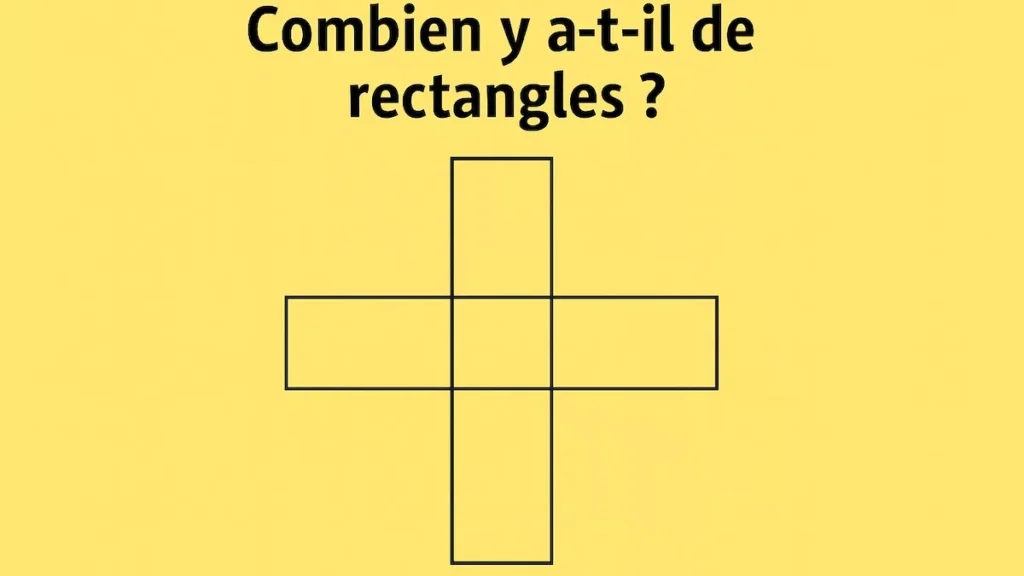
A drawing in the shape of a cross, a few straight lines, and a question that seems trivial: “How many rectangles are there?” This type of test appears straightforward. One might think, “Easy, I just count the squares and I’m done.” But, like many visual puzzles, the apparent simplicity is just a facade. Behind these lines lies a real trap for the eye and the mind.
When Our Eyes Betray Us
Naturally, we first notice what stands out: the small isolated rectangles. Our brain is satisfied with this and moves on.
However, a rectangle doesn’t have to fit within a single square. It can stretch, merge, and occupy several segments simultaneously. That’s where the mistakes begin.
Good puzzles exploit this weakness: they test not so much our calculation abilities, but our patience and rigor. Here, the goal is to learn to slow down our gaze and seek out the hidden shapes.
The Anecdote of the Geometry Professor
Once upon a time, there was an old geometry professor who loved to give this kind of figure to his students on the first day of class.
At the board, he would draw the cross and simply state:
“Count the rectangles.”
Quickly, hands would shoot up:
— “There are five!” one would say.
— “No, seven!” another would correct.
— “I see ten!” called out a third, confident in his answer.
The professor noted each response on the board without commenting. Then he added:
“It’s not your number that interests me. It’s how you search.”
Then, he walked among the rows, observing. Some scribbled frantically, others drew diagrams, and still others counted quietly. Finally, he explained:
“The biggest trap in mathematics is not making miscalculations; it’s the illusion of having finished.”
That day, many students learned a much more important lesson than the exact number of rectangles: in logic, as in life, one must learn to look beyond the obvious.
And You?
Faced with this cross, will you give in to the temptation to answer quickly?
Or will you take the time to explore each combination and verify every possibility?
The real challenge isn’t just providing the correct number of rectangles. It’s demonstrating that you know how to look differently.
Here’s the Solution We Found:
1) Quick Representation
Mentalize (or draw) the cross as a small grid of 5 unit squares:
- One center,
- 4 arms: one on the left, one on the right, one on top, one below.
We can note the integer coordinates of the squares: center (0,0), left (−1,0), right (1,0), top (0,1), bottom (0,−1).
Each rectangle we seek must be aligned with the grid and fully filled by these squares (no partially filled rectangles).
2) Strategy: Classifying by Size and Orientation
To avoid omissions, we will group rectangles by type:
A. 1×1 rectangles (units) — single squares.
B. 1×2 rectangles (two adjacent squares) — horizontal and vertical.
C. 1×3 rectangles (three aligned squares) — horizontal and vertical.
D. Larger rectangles (2×2, 2×3, etc.) — check if they exist.
Let’s count them category by category.
3) Detailed Counting
A — 1×1 (Units)
These are simply the 5 visible squares.
→ 5 rectangles
B — 1×2 (Two Adjacent Squares)
Look at all the adjacent pairs of squares that form a 1×2 rectangle.
Horizontal:
(left + center) → yes
(center + right) → yes
There are no other horizontal pairs (no square to the left of the left or to the right of the right).
→ 2 horizontal rectangles
Vertical:
(top + center) → yes
(center + bottom) → yes
→ 2 vertical rectangles
Total for 1×2: 2 + 2 = 4 rectangles
C — 1×3 (Three Aligned Squares)
Let’s find aligned triplets in a straight line:
Horizontal: (left + center + right) → these three squares do indeed form a horizontal 1×3 rectangle.
→ 1 rectangle
Vertical: (top + center + bottom) → likewise, vertical 1×3 rectangle.
→ 1 rectangle
Total for 1×3: 2 rectangles
D — Larger Rectangles (2×2, 2×3, etc.)
Let’s check for rectangles that would cover two rows and two columns (2×2) or larger.
A 2×2 would require the (left, center) squares on one row and (left, center) squares on the other row. In the cross, a corner is always missing to form a complete 2×2 block: the occupied squares never form a full 2×2 square block.
Larger ones (2×3, 3×3, etc.): impossible because the shape has only five squares and lacks the necessary continuity (there’s a gap in the corners).
→ 0 rectangles of these sizes
4) Summary and Total
- 1×1: 5
- 1×2: 4
- 1×3: 2
- Larger: 0
Add up: 5 + 4 + 2 = 11 rectangles.
5) Classic Traps to Avoid
Thinking that “counting the squares” is enough: rectangles made up of several squares (1×2, 1×3) are often overlooked.
Searching for diagonal or misaligned shapes: here we only count rectangles aligned with the grid.
Believing that a 2×2 exists without checking that all 4 corner squares are present — in the cross, one of the corners is always missing.
If you enjoyed this challenge, be sure to explore more puzzles in our recommended reading section by clicking here.
