
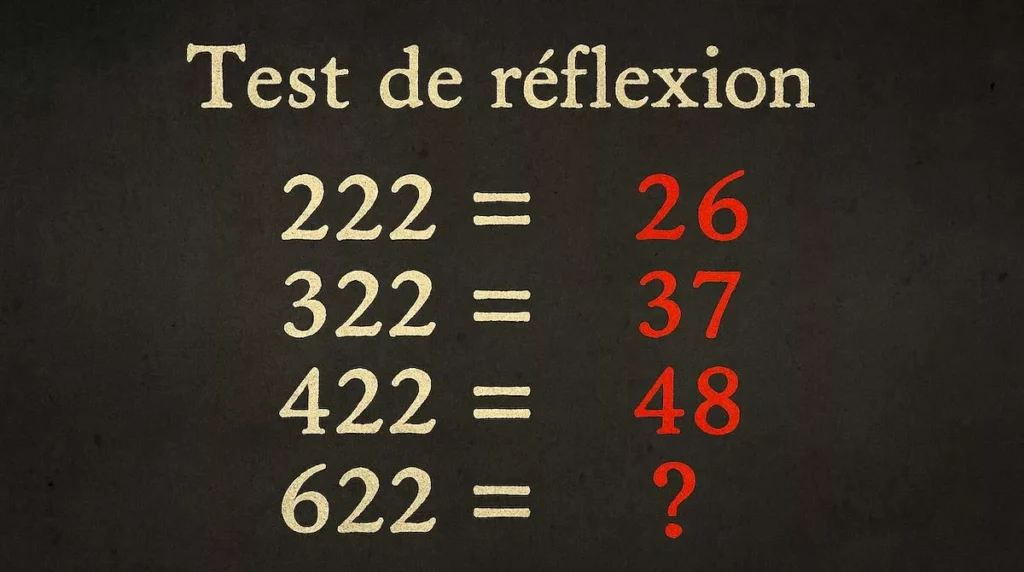
Reflection Test: A Challenge for the Mind
At first glance, this sequence appears simple: numbers lined up, an equation, and a result to find. But soon enough, something feels off. Traditional calculations don’t work, and your mathematical instincts waver. This is where the allure of the riddle lies: it cannot be solved through routine but through observation and creativity.
Thinking Outside the Box
We have all been conditioned to add, subtract, and multiply. Here, applying these rules inevitably leads to failure.
The answer is hidden elsewhere, in a subtle trick, a twist on the numbers or their positions. The “=” sign can be misleading, and the “+” symbol might not represent addition in the conventional sense.
The Challenge
Here is your sequence:
What logic lies behind these equations? And more importantly, can you discover the mechanics before resorting to mechanical calculations?
The reward is not just the answer: it’s the satisfaction of having uncovered a small secret of logical reasoning.
An Inspiration from Lewis Carroll
The story takes us back to the 19th century, to Charles Lutwidge Dodgson, better known by his pen name Lewis Carroll. Long before he became famous for Alice in Wonderland, Dodgson was a mathematics professor at Oxford. Passionate about numbers and logical games, he spent hours creating puzzles that seemed absurd at first glance.
A famous anecdote recounts how one day he presented his students with an apparently simple problem: several digits arranged in columns, with strange equalities. The results did not match traditional addition, and many gave up, frustrated.
But Dodgson, with a mischievous smile, invited them to look beyond the numbers: “It’s not the calculation that matters, but how you see the numbers,” he told them.
Students who persisted discovered an unexpected logic: the solution did not reside in direct arithmetic but in the structure of the digits themselves, or sometimes in purely symbolic manipulations, like counting the number of strokes in each digit.
This type of brainteaser, a blend of mathematics and mental play, became a signature of Dodgson, who saw it as a way to stimulate curiosity and creativity rather than test memory or calculation speed.
Observe Before Concluding
Before jumping to an answer, take a moment to analyze the structure. Each line may contain an invisible clue, a twisted rule, or an unexpected transformation.
Sometimes, the solution lies in simple observation: counting strokes, letters, or imagining a non-numerical connection.
Here Is The Solution We Found:
1. Observe The Numbers
We notice that each line follows the structure XYZ = ?:
X can change (2, 3, 4, 6)
Y and Z remain fixed at 2 and 2.
The results (26, 37, 48…) do not correspond to traditional addition. So we need to seek a different type of relationship.
2. Look For A Pattern
We might ask:
Is the result linked to the sum of the digits?
222 → 2+2+2 = 6 (but the result is 26, so no)
Perhaps X and the two 2s combined differently?
Notice that:
222 → 26
322 → 37
422 → 48
The first part of the result increases by 1 each time, and the second does too. This suggests a relationship based on X.
3. Test A Simple Hypothesis
We can look at the pattern position by position:
Maybe the result = X × 10 + (2 + 2)?
2 × 10 + (2+2) = 20 + 4 = 24 → not 26.
Or X × 10 + X + 2 = ?
Or counting the strokes in each digit: some puzzles count the number of segments needed to write each digit on a digital display:
2 → 5 segments
3 → 5 segments
4 → 4 segments
etc.
4. Final Deduction
In general, this type of puzzle follows the rule: the result = X × (Y+Z) + something.
If we apply the logic to 622, we follow the same rule as for the previous lines.
So the answer unfolds in three steps:
Observe the pattern of numbers and results.
Look for an unconventional rule (sum of digits, multiplication, or stroke counting).
Apply the rule to the last number to find the final result.
Identified Rule
The result is the concatenation of:
- The first digit from the left (X),
- The sum of the three digits.
Verification:
- 222 → first digit 2; sum 2+2+2 = 6 → 26
- 322 → 3; 3+2+2 = 7 → 37
- 422 → 4; 4+2+2 = 8 → 48
Application to 622
- First digit: 6
- Sum: 6+2+2 = 10
622 = 610
If you enjoyed this game, be sure to tackle other challenges in our recommended reading section by clicking here.
