
A Math Riddle… Or a Trap for the Mind?
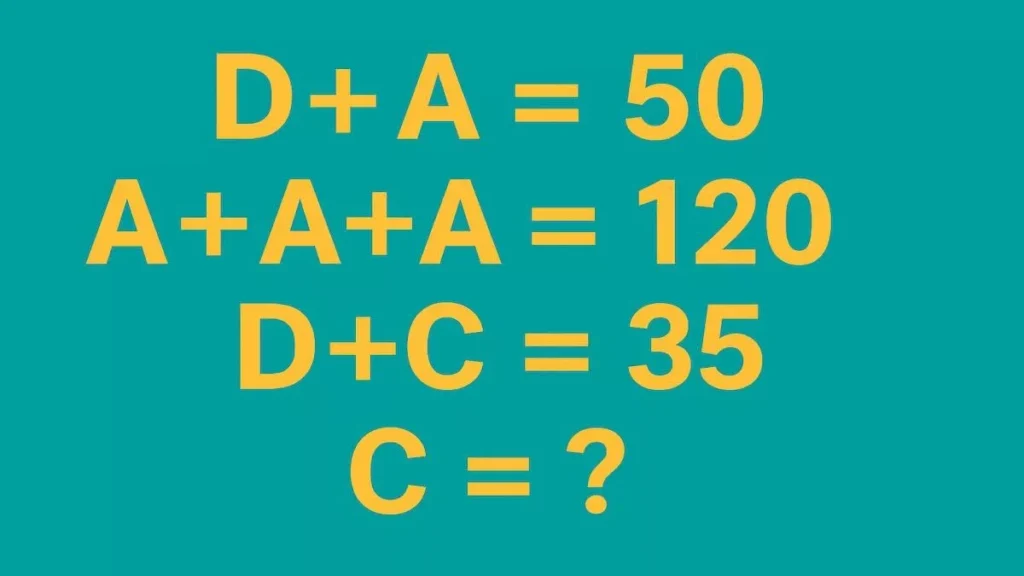
At first glance, it seems like just a simple exercise. Three equations, a few letters, and a question mark waiting to be solved. D + A = 50, A + A + A = 120, D + C = 35… and C = ?
Simple, right? Yet…
The Facade of Simplicity
This test is a perfect example of brain teasers that play with our perception. The dressing may be mathematical, but the real mechanics are logical. It’s not just about calculating; it’s an invitation to observe differently.
Here, the numbers serve as clues. The letters represent unknowns to be tamed. It’s not about applying a formula but about unraveling a knot. The one we often create ourselves by rushing in, thinking we already know.
An Anecdote for Inspiration: The Perspective of a Brilliant Child
It is said that one day, a teacher gave his students a series of calculations to solve quickly. Among them was a quiet little boy who kept his head down. He observed each line for a long time, wrote little. When the teacher passed by, he gently said:
— I don’t just want to do the calculations, sir. I want to understand why the results are what they are.
This boy was Carl Friedrich Gauss, one of the greatest mathematicians in history. At the age of 7, he was already impressing others with his ability to see beyond appearances. For him, every riddle was an opportunity to think differently.
And that’s exactly the mindset to adopt here.
An Equation… Or an Investigation?
Ask yourself: what do you really know?
You have three lines. Relationships between D, A, and C. It’s up to you to unravel them:
- D + A = 50
- A + A + A = 120
- D + C = 35
Once A is found, the rest follows. But you must isolate it well and understand its true value. This is not a race. It’s a construction.
The Joy of Discovery
This kind of riddle cannot be solved with a calculator but requires a touch of logic, a bit of patience, and a desire to seek.
For it’s not the answer that counts… but the journey you take to reach it.
Here’s the Solution We Found:
Step 1: Find the Value of A
We have: A + A + A = 3A = 120
Thus: A = 120/3 = 40
Step 2: Find the Value of D
We know that: D + A = 50
Substituting A for 40: D + 40 = 50
Thus: D = 50 – 40 = 10
Step 3: Find the Value of C
We have: D + C = 35
Substituting D for 10: 10 + C = 35
Thus: C = 35 – 10 = 25
Final Results:
A = 40
D = 10
C = 25
So, were you on the right track? Did you find it? Whether you arrived at the answer or not, what matters is that you tried the experience.
If you enjoyed this challenge, don’t forget to tackle more in our recommended reading section by clicking here.
