
A Mundane Sequence… Or a Door to Abstraction?
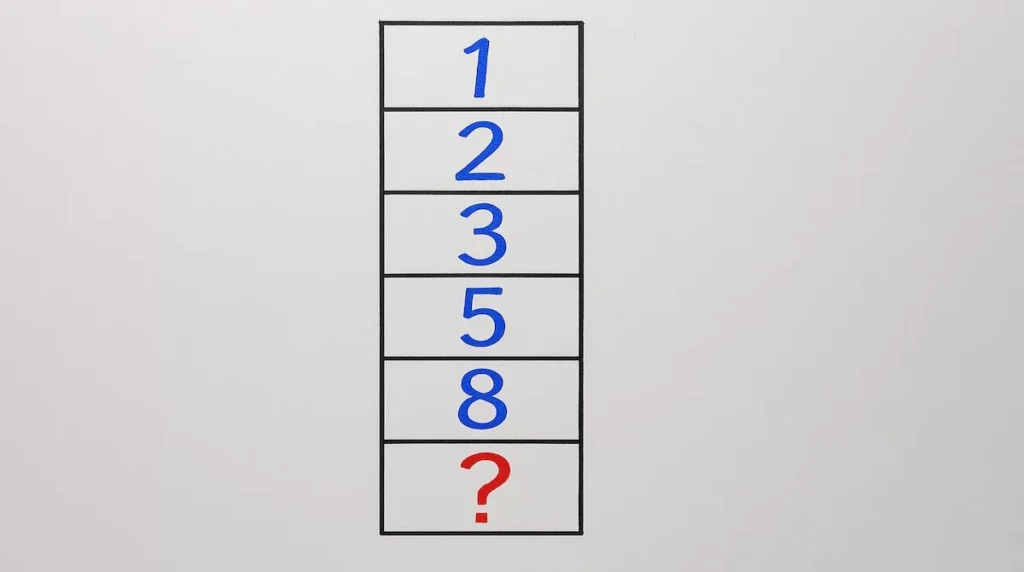
At first glance, this series of numbers may seem quite simple. Neatly arranged digits, following each other almost obediently in a column. Yet, just one empty box can stir doubts. That box at the bottom poses a question that only the keenest observers will decipher.
What Seems Obvious… Isn’t Always
1, 2, 3, 5, 8… then nothing. An empty space.
And there you are, searching for the connection between these numbers. An addition? A forgotten school rule?
This test appears to be a nod to the fundamentals of mathematics… yet it compels you to slow down and think as you did on your very first day.
Where Mathematics Meets Intuition
This puzzle not only assesses your knowledge but, more importantly, your observational skills. Here, there’s no need for a calculator.
What’s required is to notice what your eyes reveal, which your mind might overlook. A logic that is almost gentle, familiar, yet sometimes lost in haste.
A Lesson Hidden Among the Numbers
Did you know that Leonardo of Pisa, better known as Fibonacci, introduced a brilliantly simple idea to Europe: that sequences can emerge from nothing, or nearly so?
He was inspired by rabbits reproducing to demonstrate a series of numbers… and since then, this sequence is found everywhere in nature, art, and music. Perhaps you encounter it here, without even realizing it.
An Invitation to Slow Down
Before you frantically click “solve,” take a moment. Let the numbers speak to you. Look for the subtle connections.
For in this type of test, it’s not just the correct answer that matters, but the method you used to arrive at it.
Here’s the Solution We Found:
Step 1: Observe the Given Numbers
The sequence starts with:
- 1
- 2
- 3
- 5
- 8
We notice that these numbers seem to add up in a certain way.
Step 2: Identify the Logical Rule
Let’s look at the relationships between the numbers:
1 + 2 = 3
2 + 3 = 5
3 + 5 = 8
Here we see a Fibonacci sequence, a famous mathematical progression where each term is the sum of the two preceding ones.
Step 3: Apply the Rule
If we continue the logic:
- 5 + 8 = 13
Conclusion
Thus, the missing number is 13, as it is the sum of the two previous numbers (5 and 8), according to the Fibonacci sequence.
So, were you on the right track? Did you find it? Regardless of whether you discovered the answer or not, the essential part was to engage with the experience.
If you enjoyed this challenge, don’t forget to tackle more puzzles from our recommended reading section by clicking here.
