
Geometric Illusions That Play with Our Minds
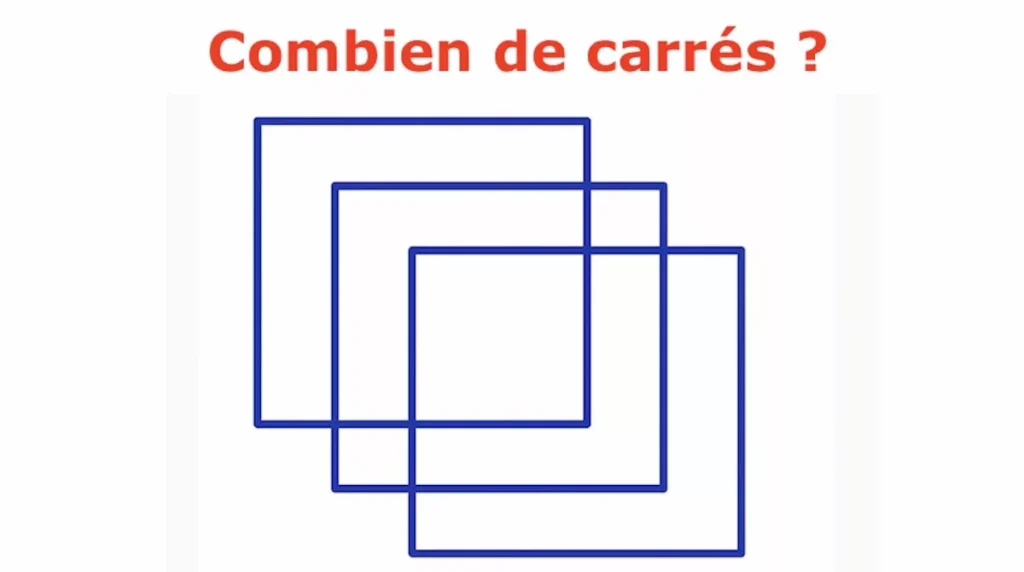
Some puzzles require neither calculations nor formulas. Just… careful observation. These visual challenges, seemingly simple, disrupt our certainties and awaken our sense of observation. Today, a minimalist yet formidable challenge: How many squares do you see in this image?
A Trap for Our Perception
Three large blue squares. Is that all? Not so fast…
This type of image, widely shared on social media, appears basic at first glance. However, doubts quickly arise.
What if it’s not that simple? What if more squares are hidden from view, not by color, but by arrangement?
Here, it’s not just our eyes we need to question, but our attention. Our brains love to fill in gaps, ignore the obvious, and simplify what we see.
This is precisely what this test exploits.
A Personal Memory: The Day I Miscounted the Squares
I remember an exercise given during a logic workshop. The prompt seemed childlike: “How many triangles do you see?” I counted seven… There were thirteen.
The lesson was simple: What we see isn’t always what is. Sometimes, you need to step back, spot hidden shapes, groupings, and overlaps. Just like here.
Why Do We Enjoy These Challenges?
Because they activate another form of intelligence: structured visual perception.
These puzzles teach us to:
- Pay attention to details,
- Look at things differently,
- Question our first impressions.
And above all, they are fun, viral, and shareable. They spark conversations with family, friends, and on social media. And when the solution is revealed… it often brings a smile.
It’s Your Turn!
Take your time. Don’t rely on your first impression. Count the squares… all the squares. Not just the obvious ones.
Hint: Some squares are formed by the combination of several others. It’s not enough to see the outlines; you need to see the whole.
So, how many squares are there really in this image?
Share this challenge and compare your answers… Who can observe beyond the lines?
Here is the solution we found:
Logical Process of the Solution:
1. Identify the Obvious Squares
Start by observing the whole and distinct squares:
- There are 3 large blue squares drawn individually.
Total: 3 squares
2. Look for Squares Formed by Overlaps
Next, see where the squares intersect. Some partial or whole squares appear through the fusion of parts of two or more squares:
- When two squares overlap, they create a new square in the shared area.
- Look for intermediate-sized squares.
Here’s what can be spotted (according to the image):
- 2 squares formed by the intersection of two squares.
- 1 square formed by the central area where the 3 squares intersect.
Total: 3 additional squares
3. Search for “Hidden” Squares (Visual Groupings)
These are the hardest to spot: Some squares are created by grouping segments from several squares. We call them composite squares.
- 1 or 2 large squares can be formed by assembling corners from different squares.
- These squares are not explicitly drawn, but their outline is complete.
You can typically find 2 hidden squares this way.
Conclusion
In total:
- 3 visible squares
- 3 squares derived from overlaps
- 2 composite squares
Final Total: 8 squares
Why Does This Puzzle Fool So Many People?
Because our brains tend to see the drawn shapes, but not those implied by the composition. This is a classic cognitive illusion: we perceive parts, but not always the whole.
So, were you on the right track? Did you find the answer? Whether you got it right or not, the important part is to have tried the experience.
If you enjoyed this game, don’t forget to take on more challenges from our recommended reading section by clicking here.
