
A Challenge Shared on Social Media
A challenge circulated on social media invited users to solve a tricky equation without using a calculator. For many of us, math in school was more a source of stress than excitement.
However, the growing popularity of mathematically-based puzzles is changing this perception.
These clever riddles combine logic, numbers, and a dose of distraction, transforming mathematics into a fun, fascinating, and even addictive subject.
Mathematics as a Mental Game
Whether you’re a self-proclaimed number fanatic or someone who vowed to never revisit algebra, there’s something undeniably captivating about a challenge designed to stump the average mind. In an age of fast scrolling and fleeting attention, a good puzzle provides an opportunity for mental engagement: brief, impactful, and satisfying.
The Challenge
A recently shared equation on social media left internet users both amused and puzzled.
The challenge is to solve a seemingly simple equation using only your brain:
“Without a calculator, just with your brain, solve this: 60 + 20 + 6 – 10 × 0 = ?”
Another Challenge
This isn’t the first time a mathematical puzzle has confused social media users.
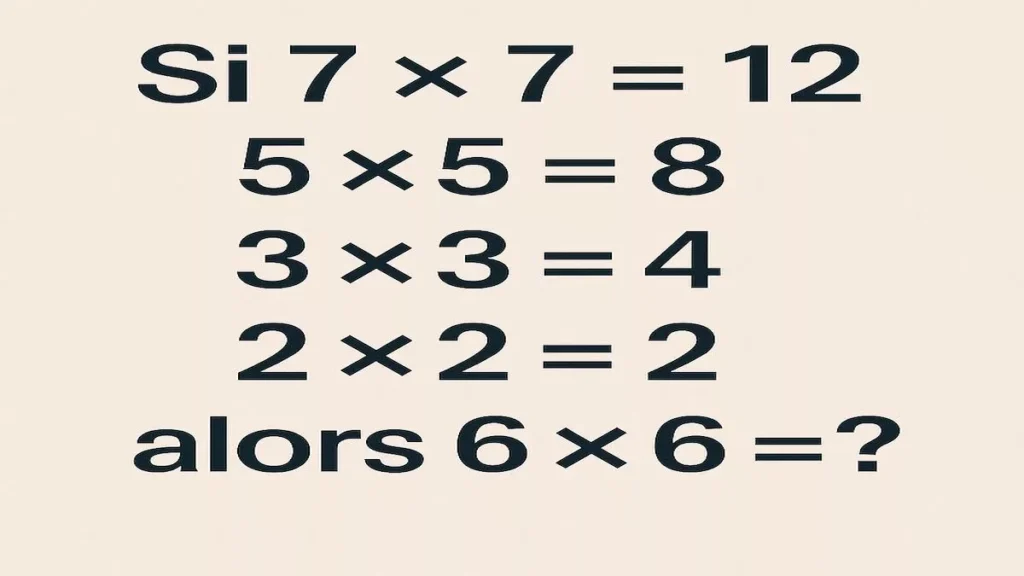
A previous challenge went viral due to its unique set of equations:

Unlike classic arithmetic problems, this skill game relies on pattern recognition rather than mathematical precision.
The goal isn’t necessarily to find the correct answer in the traditional sense, but to discern the underlying logic, or even invent one, sparking debate, guesses, and theories among users.
The Lasting Appeal of Puzzles
What makes these puzzles so popular is their ability to challenge us in unexpected and stimulating ways.
They disrupt habitual thinking, test our mental agility, and often lead to moments of surprise, satisfaction, and even a bit of introspection when we realize how easily simple logic can mislead us.
Have You Found the Solutions?
Here Are the Solutions We Found:
The First Challenge:
60 + 20 + 6 – 10 × 0 = ?
Here, the common mistake is ignoring the order of operations (the famous PEMDAS/BODMAS rules).
Multiplication takes precedence over addition and subtraction, so:
10 × 0 = 0
60 + 20 + 6 = 86
86 – 0 = 86
Therefore, the answer is: 86
The Second Challenge (logic rather than arithmetic):
If 7 × 7 = 12, 5 × 5 = 8, 3 × 3 = 4, 2 × 2 = 2, then 6 × 6 = ?
Here, it’s not about pure mathematics, but about identifying a “hidden” pattern or logic.
Looking at the results:
7 × 7 = 12
5 × 5 = 8
3 × 3 = 4
2 × 2 = 2
We can notice that the final result corresponds to the number of letters in the written version of the result of the operation:
7 × 7 = 49 → “forty-nine” (12 letters)
5 × 5 = 25 → “twenty-five” (8 letters)
3 × 3 = 9 → “nine” (4 letters)
2 × 2 = 4 → “four” (6 letters… except here it’s 2, maybe a simpler pattern?)
However, since the sequence isn’t strict, some interpret it as the square root of the final result, or as a descending series of numbers: 12, 8, 4, 2…
The sequence (12 → 8 → 4 → 2) divides by 2 each time.
Thus, the next number in the sequence would be 1.
So:
6 × 6 = 1
And remember, if you don’t want to keep having fun with tests and challenges, definitely don’t click here.
